
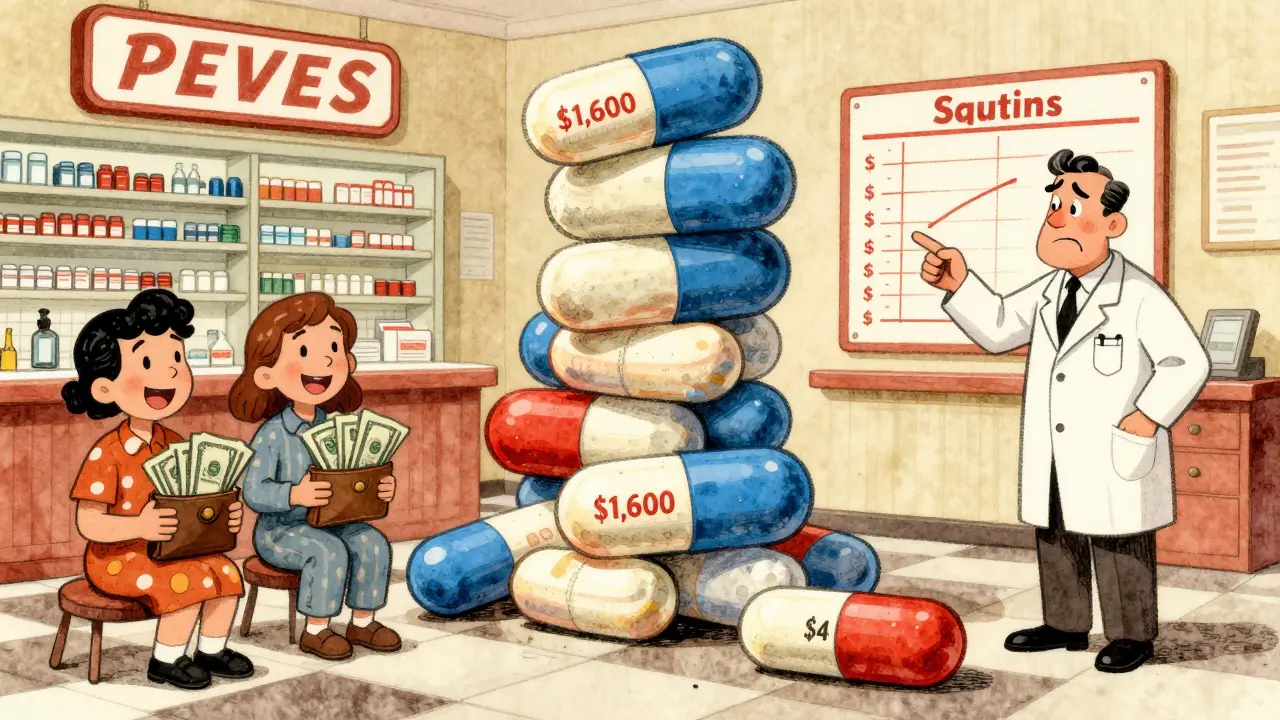
Every year, Americans fill over 3.9 billion prescriptions for generic medications. That’s nine out of every ten prescriptions written. And yet, these pills and capsules account for just 12% of total drug spending. Meanwhile, brand-name drugs-filled less than 500 million times-consume nearly 90% of the money spent on prescriptions. This isn’t a glitch. It’s the system working exactly as designed. And it’s saving the U.S. healthcare system hundreds of billions each year.
How Generics Cut Costs by 80% or More
Generic drugs aren’t cheaper because they’re low quality. They’re cheaper because they don’t need to recoup billions in research and marketing costs. Once a brand-name drug’s patent expires, any manufacturer can make an identical version. The FDA requires generics to have the same active ingredient, strength, dosage form, and route of administration. They must also prove they work the same way in the body. No extra steps. No hidden tricks. Just the same medicine at a fraction of the price. In 2024, the average cost of a brand-name prescription was $1,600. The generic version? Around $15. That’s a 99% drop in price for the same therapeutic effect. For chronic conditions like high blood pressure, diabetes, or high cholesterol-conditions millions of Americans manage daily-switching to generics means saving hundreds, sometimes thousands, per year. Take lisinopril, the generic version of the brand-name drug Zestril. A 30-day supply of Zestril might cost $120 without insurance. The generic? $4. That’s $1,152 in annual savings per person. Multiply that by the 30 million Americans taking this drug, and you’re looking at $34.5 billion saved in one year alone.The Trillion-Dollar Impact: Real Numbers, Real People
From 2015 to 2024, generic and biosimilar medications saved the U.S. healthcare system a total of $3.4 trillion. That’s not a guess. It’s from the Association for Accessible Medicines and IQVIA Institute’s official 2025 Savings Report. In 2024 alone, generics and biosimilars saved $467 billion. That’s more than the entire annual budget of the Department of Education. Biosimilars-generic versions of complex biologic drugs like Humira or Enbrel-are a newer but rapidly growing part of this story. Since the first biosimilar entered the market in 2015, they’ve saved $56.2 billion. In 2024, they saved $20.2 billion. These aren’t small wins. They’re game-changers for patients with autoimmune diseases, cancer, and other serious conditions who used to pay $10,000 to $20,000 a year for one drug. Now, biosimilars bring those costs down to $3,000-$6,000. The savings aren’t just theoretical. In 2024, Medicare saved $142 billion because of generics. Medicaid saved $62.1 billion. Private insurers saved even more. For families, that means lower premiums. For taxpayers, it means less pressure on federal spending. For hospitals, it means more room in budgets to hire nurses, upgrade equipment, or expand mental health services.Why Some People Still Pay Too Much for Generics
Even with all these savings, many Americans still pay more than they should for generics. Why? Because the system isn’t always transparent-or fair. Pharmacy Benefit Managers (PBMs), the middlemen between insurers, pharmacies, and drugmakers, often steer patients toward higher-cost brand drugs-even when a generic is available. How? Through rebates. PBMs get kickbacks from brand manufacturers to keep their drugs on preferred lists. That means your insurance plan might make it harder to get the cheaper generic, even if it’s just as effective. A 2023 survey of 500 patients found that 42% skipped filling prescriptions because of cost. But among those who switched to generics, 89% said they were satisfied with the results. The problem isn’t the medicine. It’s the system. Another issue: some pharmacies still charge more for generics than the actual cost. In states without mandatory substitution laws, pharmacists can charge whatever they want. In California, where laws require substitution unless the doctor says no, generic utilization hits 98%. In Texas, where rules are looser, it’s only 87%.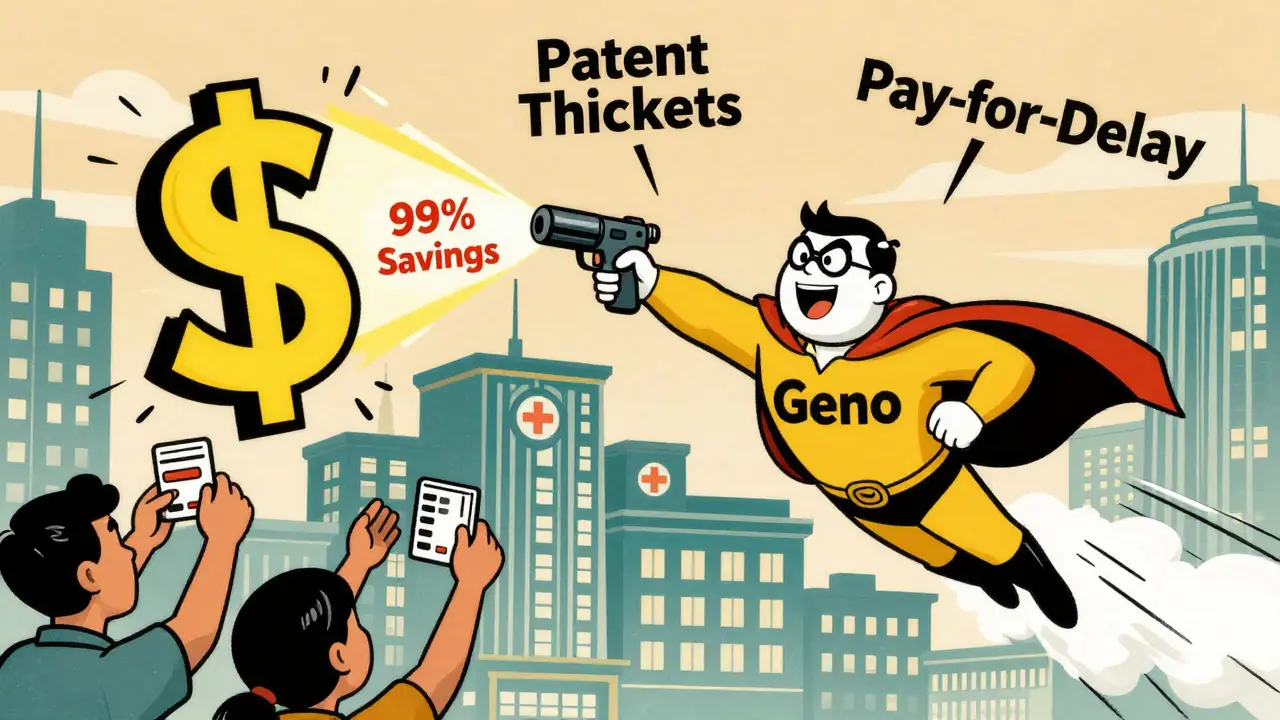
The Hidden Barriers: Patents, Delays, and Corporate Tactics
Big Pharma doesn’t want generics to win. So they’ve built a wall of legal tricks to delay them. One tactic is called “patent thickets.” Instead of one patent, a company files dozens-covering everything from pill coatings to manufacturing methods. This makes it harder for generic makers to enter the market without getting sued. A 2024 JAMA Health Forum study found that just four brand-name drugs, protected by these thickets, cost the system over $3.5 billion in two years. Another is “pay-for-delay.” A brand-name company pays a generic maker to stay off the market. In exchange, the generic company agrees not to sell its cheaper version for years. The Congressional Budget Office estimates these deals cost federal programs $3 billion a year. Blue Cross Blue Shield says they drive up overall drug prices by $12 billion annually. Then there’s “product hopping.” A company slightly changes a drug-say, switching from a pill to a capsule-and then pushes doctors to prescribe the new version. The old one loses patent protection. The new one gets a fresh 20-year monopoly. Patients get stuck paying more for a drug that’s functionally identical.What’s Working: State Laws, Policy Wins, and Real Change
Some places are fighting back-and winning. California’s Generic Drug Discount Program forces pharmacies to dispense generics unless the prescriber writes “dispense as written.” Result? 98% of prescriptions filled are generic. The state saves hundreds of millions every year. In 2024, the Senate HELP Committee passed S.1041, the Affordable Prescriptions for Patients Act. It targets pay-for-delay deals, limits patent thickets, and stops product hopping. The Congressional Budget Office says it could save $7.2 billion a year. Pharmacy Benefit Managers are starting to change too. Express Scripts reported $18.3 billion in savings from generic substitution in 2023. They’re now prioritizing generics in their formularies-not because they’re nice, but because it saves money.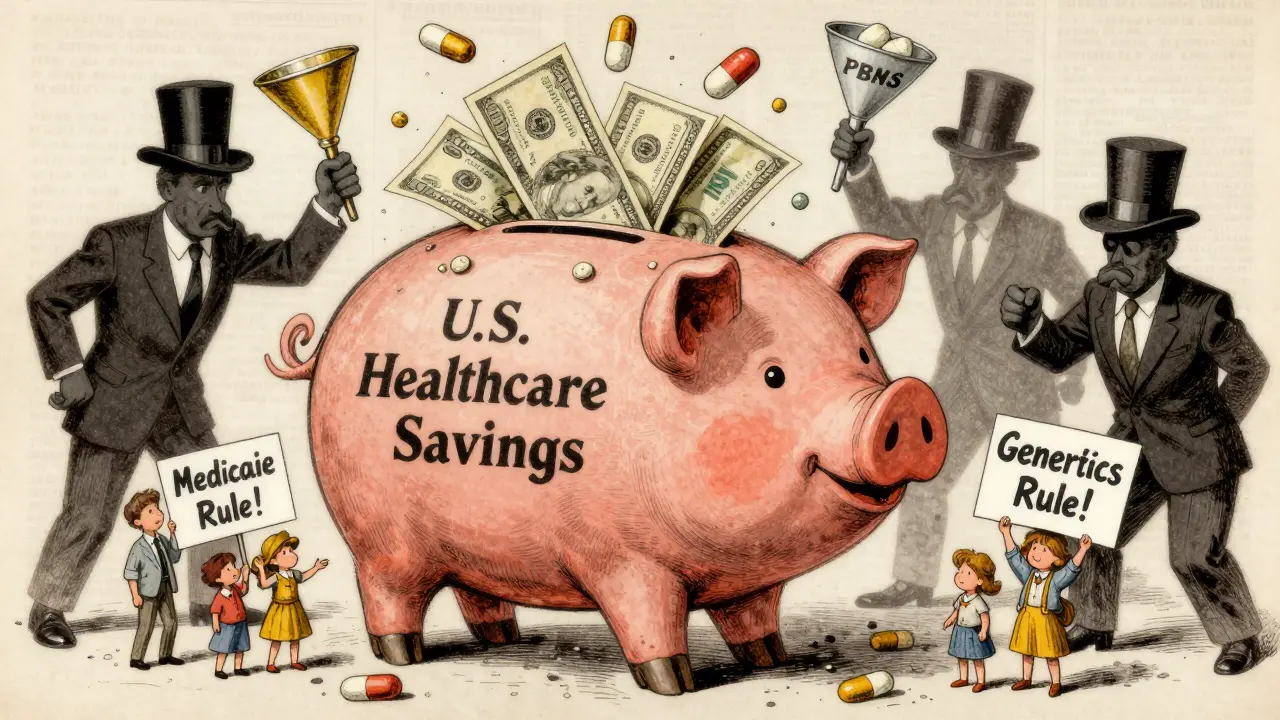
The Future: More Generics, More Savings
The FDA approved 1,145 new generic drugs in 2024-up 7.3% from the year before. Another $24 billion in drug spending is waiting to go generic by 2025. That includes complex injectables, inhalers, and specialty medications for cancer and rare diseases. Biosimilars are accelerating fast. The market grew 22.7% in 2024 and is projected to hit $40 billion by 2029. More interchangeability designations-where pharmacists can swap biosimilars for brand drugs without asking the doctor-are coming. That will cut costs even further. The IQVIA Institute projects that from 2025 to 2034, generics and biosimilars will save the U.S. healthcare system $5.1 trillion. That’s more than the entire GDP of Canada.What You Can Do
You don’t need to wait for Congress or a state law to save money. Here’s what works right now:- Always ask your doctor: “Is there a generic version of this?”
- Compare prices at different pharmacies. Some charge $4 for generics. Others charge $40.
- Use mail-order pharmacies. They often offer 90-day supplies at lower prices.
- Check if your plan has a preferred generic list. Stick to those.
- If you’re on Medicare Part D, review your plan’s formulary every year. Plans change.
Kayla Kliphardt
I had no idea generics saved $467 billion last year alone. I always assumed they were just 'good enough'-but learning they're FDA-approved to be identical? That changed how I see my blood pressure meds. I switched to lisinopril last year and haven't looked back.
Robb Rice
Generics are the unsung heroes of American healthcare. The math is undeniable. A $15 pill replacing a $1,600 one isn't just smart-it's moral. The fact that PBMs still push brand names for kickbacks is criminal. Someone needs to hold these middlemen accountable.
Harriet Hollingsworth
This is why I hate big pharma. They'll do ANYTHING to keep you paying. Pay-for-delay? Patent thickets? Product hopping? It's not capitalism-it's theft. And we're the ones getting robbed while they sip champagne on yachts.
Deepika D
As someone who grew up in India where generics are the norm, I can tell you this isn't just about cost-it's about access. In the U.S., we treat medicine like a luxury item. But in many countries, generics are the only way people survive chronic illness. This post made me proud to see the U.S. finally catching up. The real win? When biosimilars hit $40 billion by 2029. That’s hope for millions with autoimmune diseases. Keep pushing for policy change. Every generic you take is a vote for justice.
Jenny Salmingo
I used to be scared of generics because I thought they were 'cheap stuff.' Then my grandma switched to the generic for her diabetes med and said, 'Honey, it works just fine.' She’s 82 and still gardening. That’s all I needed to know.
Aaron Bales
Always ask for the generic. Always. It’s free advice that saves you hundreds.
Lawver Stanton
Look, I get it-generics save money. But let’s be real: the system is rigged. I took a generic for my cholesterol last year and got dizzy every morning. My doctor said it was 'psychosomatic.' I switched back to the brand and the dizziness vanished. So yeah, maybe generics work for most people-but when your body says no, you listen. And if the system forces you to pick the cheaper option even when it doesn’t work? That’s not healthcare. That’s cruelty dressed up as savings.
Sara Stinnett
How quaint. You treat pharmaceuticals like toothpaste. 'Same active ingredient'-sure, if you believe in fairy tales. But pharmacokinetics aren't binary. The excipients, the coating, the dissolution rate-these things matter. Your 'identical' generic might have a 12% variance in bioavailability. That’s not medicine. That’s Russian roulette with your liver. And you call this progress? This isn't saving the system-it’s cannibalizing it.
linda permata sari
I’m from Indonesia and we use generics every day. No one here thinks they’re 'second best.' They’re just… medicine. The fact that Americans treat generics like a scandal is wild. I wish we could export our common sense.
Brandon Boyd
One small step: next time you’re at the pharmacy, ask the pharmacist if they can match the $4 generic price. Most will. You’re not being pushy-you’re being smart. And if they say no? Walk out. There’s another pharmacy two blocks away. You’ve got power. Use it.