
PML Risk Calculator
Assess Your PML Risk
This calculator estimates your risk of Progressive Multifocal Leukoencephalopathy (PML) based on your medical history and test results. PML is a rare but serious condition associated with certain immunosuppressant medications.
Imagine taking a drug that controls your multiple sclerosis or Crohn’s disease, only to find out it could trigger a rare but deadly brain infection. That’s the reality for some people on powerful immunosuppressants. Progressive Multifocal Leukoencephalopathy, or PML, isn’t something you hear about often-but when it happens, it changes everything. It doesn’t come with a warning label you can easily spot. No fever, no rash. Just slow, silent damage to your brain that can turn into paralysis, vision loss, or death. And the biggest trigger? Medications meant to calm your immune system.
What Exactly Is PML?
PML is caused by the JC virus, which most adults carry without ever knowing. Around 50 to 70% of people have it hiding quietly in their kidneys or bone marrow. It’s harmless-until your immune system gets knocked down. That’s when the virus wakes up, travels to your brain, and starts eating away at the white matter that helps your nerves communicate. The result? Progressive damage in multiple areas of the brain, hence the name: progressive multifocal leukoencephalopathy.
This isn’t a common infection. It’s rare. But when it hits, it’s brutal. About 30 to 50% of people die within months. Those who survive often lose the ability to walk, speak, or care for themselves. There’s no cure. Treatment focuses on stopping the drug that caused it and trying to rebuild your immune system fast enough to fight back-without causing even more damage.
Which Immunosuppressants Carry the Highest Risk?
Not all immunosuppressants are created equal when it comes to PML risk. Some are far more dangerous than others.
Natalizumab (Tysabri) is the biggest red flag. Used for multiple sclerosis and Crohn’s disease, it blocks immune cells from entering the brain-which sounds helpful until you realize it also traps the JC virus inside. Between 2004 and 2011, 102 people on Tysabri developed PML. Today, the risk jumps dramatically if you’ve had other immunosuppressants before, like methotrexate or azathioprine. In those cases, your risk becomes 2.5 times higher.
Other high-risk drugs include:
- Fingolimod (Gilenya): 0.4 cases per 1,000 patients
- Rituximab (Rituxan): 0.8 cases per 1,000 patients
- Dimethyl fumarate (Tecfidera): 0.2 cases per 1,000 patients
Compare that to older MS drugs like interferon beta or glatiramer acetate-where no confirmed PML cases have ever been reported. That’s why many neurologists now avoid natalizumab unless other treatments have failed.
The JC Virus Test: A Flawed Shield
Before starting natalizumab, your doctor is supposed to test you for JC virus antibodies. If you’re negative, your risk is extremely low-less than 1 in 1,000. If you’re positive, your risk goes up. But here’s the catch: the test isn’t perfect.
About 2 to 3% of people who test negative still have the virus hiding in their body. That’s not a small number. One Reddit user, u/MSWarrior2023, found early PML lesions on an MRI even though their JC virus test came back negative. They weren’t alone. A 2017 study in Neurology confirmed this blind spot. False negatives happen. And when they do, people get caught off guard.
Even among those who test positive, risk isn’t just yes or no. A newer tool called the JC virus antibody index gives a number. If your index is below 0.9, your risk after 4 years of natalizumab is only 0.09%. But if it’s above 1.5? Your risk jumps to nearly 11%. That’s why some clinics now track this number every six months-not just a one-time test.
What Makes the Risk Worse?
It’s not just the drug. It’s the combination.
If you’ve ever taken another immunosuppressant before starting natalizumab, your risk skyrockets. The FDA specifically asks doctors: “Has the patient ever taken an immunosuppressant before starting Tysabri?” That’s not a casual question. It’s a life-or-death filter. People with prior exposure-especially to drugs like mitoxantrone or azathioprine-can develop PML in as little as 6 to 12 months on natalizumab, instead of the usual 24+ months.
Another hidden risk factor? Low lymphocyte counts. If your absolute lymphocyte count drops below 0.8 x 10⁹/L, your risk of PML increases fourfold. This is especially true for people with blood cancers on drugs like ibrutinib. A 2021 study in the Journal of Clinical Oncology found these patients had a 12.7 times higher risk than organ transplant recipients.
And then there’s IRIS-immune reconstitution inflammatory syndrome. When doctors stop the drug and your immune system tries to recover, it can go haywire. Instead of calming the infection, it attacks your brain tissue. Half to 60% of PML patients on natalizumab develop IRIS. It’s like swapping one fire for another.
How Do Doctors Catch It Early?
Early detection is the only thing that gives you a fighting chance.
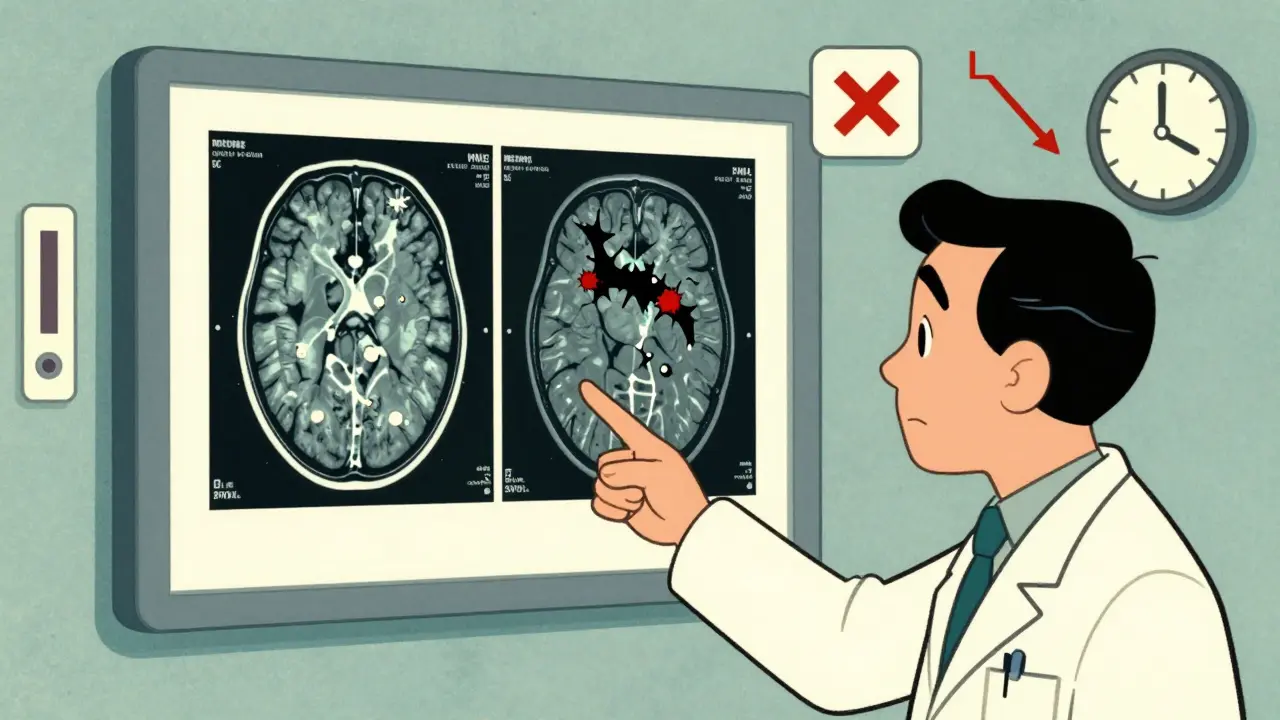
Neurologists now recommend brain MRIs every 3 to 6 months for people on high-risk drugs. But here’s the problem: PML lesions look a lot like MS flare-ups on MRI. It takes 15 to 20 hours of special training for radiologists to tell the difference. Many community clinics don’t have that expertise.
That’s why symptoms matter just as much as scans. Watch for:
- Sudden weakness on one side of the body
- Blurred or double vision
- Slurred speech or trouble finding words
- Loss of coordination or balance
- Mental confusion or memory problems
These aren’t normal MS symptoms. They’re sharp, new, and often progress over days-not weeks. If you notice any of these, tell your doctor immediately. Don’t wait. Don’t assume it’s a relapse. PML doesn’t wait.

What Are People Really Feeling?
Beyond the numbers, there’s fear.
On the National Multiple Sclerosis Society’s forums, 78% of people on natalizumab say they live with “extreme anxiety” about PML. One woman wrote: “I’m terrified every time I get a new MRI. I don’t know if I’ll get another scan or if this will be the one that shows it.”
Some people quit their medication after 24 months-even if it’s working perfectly-just to avoid the risk. Others switch to drugs with lower PML risk, like ocrelizumab, even if those drugs have their own side effects.
But there’s hope, too. One user, u/NatalizumabSurvivor, shared how catching PML early saved them. Their doctor stopped natalizumab at the first sign of trouble. They got high-dose steroids to manage IRIS. Six months later, they’d regained 90% of their movement. Their story isn’t common-but it proves that timing matters.
What’s Changing in 2025?
There’s new research. New hope.
A new experimental therapy called DIAVIS T-cell therapy showed a 68% reduction in death and better recovery in a small 2024 study. Immune checkpoint inhibitors like pembrolizumab are also being tested-with 27% of patients showing improvement. The Cleveland Clinic is now running a Phase II trial testing maraviroc, an HIV drug, to prevent PML in high-risk natalizumab patients.
By 2030, experts predict PML risk from natalizumab could drop to 0.5 cases per 1,000 patient-years-thanks to better screening, earlier detection, and smarter treatment choices. That could bring it back into the conversation as a first-line option for some.
For now, the message is simple: Know your risk. Know your numbers. Don’t ignore subtle changes in your body. And never assume a negative test means you’re safe.
What Should You Do If You’re on Immunosuppressants?
Here’s what to do right now:
- Ask your doctor for your JC virus antibody test result-and the index number, if available.
- Find out if you’ve ever taken another immunosuppressant. That history matters.
- Confirm you’re getting regular MRIs (every 3-6 months).
- Know the warning signs of PML. Write them down. Show them to a family member.
- If you feel something’s off-don’t wait. Call your neurologist the same day.
PML isn’t something you can ignore. But it’s also not something you have to live in terror of. Knowledge is your best defense. Stay informed. Stay alert. And don’t let fear stop you from getting the treatment you need-just make sure you’re watching for the red flags.