
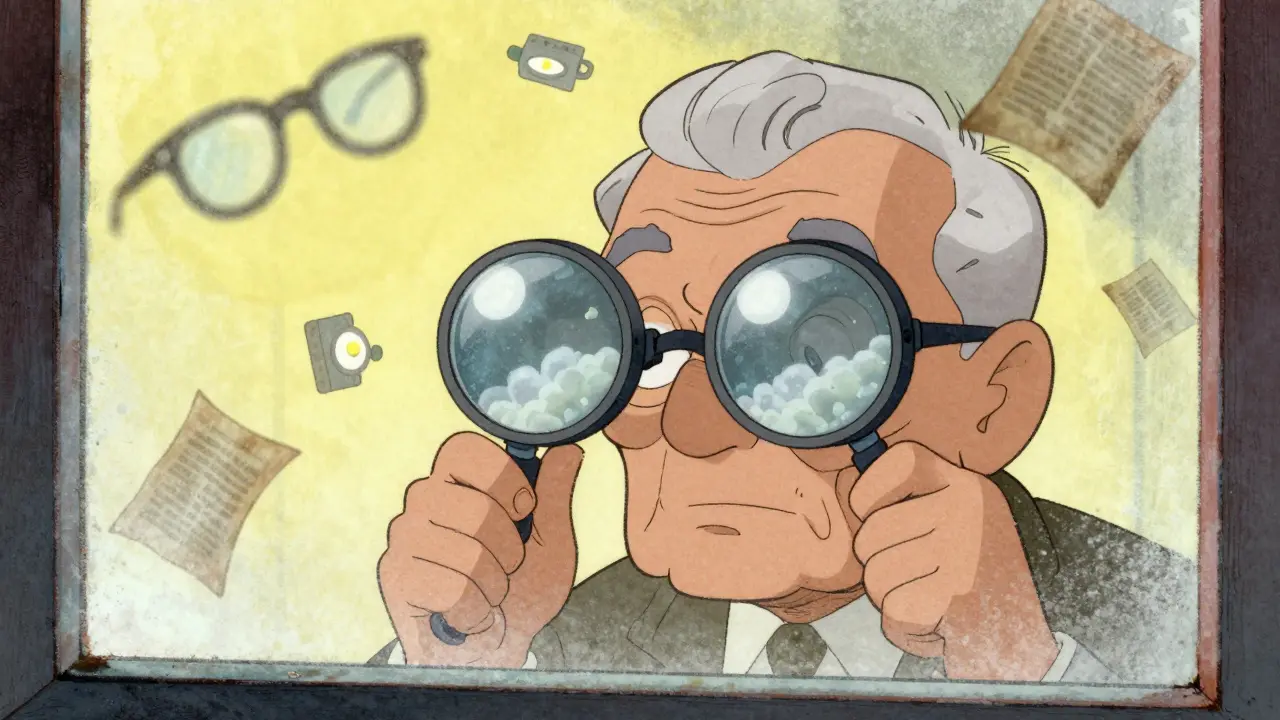
By age 80, more than half of all Americans have cataracts. It’s not rare. It’s not unusual. It’s just part of aging for many people. But that doesn’t mean you have to live with blurry vision, glare at night, or colors that look faded. Cataracts are a clouding of the eye’s natural lens - not a film over the eye, not a growth, not something you can rub away. It’s a change inside the lens itself, where proteins clump together over time and scatter light instead of focusing it. The result? Vision that feels like looking through a frosted window.
What Exactly Happens in the Eye?
Your lens is like a clear, flexible camera lens inside your eye. It changes shape to help you focus on things near and far. As you get older, the proteins in that lens start to break down and stick together. This clumping creates cloudy areas. It doesn’t hurt. It doesn’t burn. But it slowly steals your clarity. You might notice:
- Colors look dull or yellowish
- Glare from headlights or sunlight becomes blinding
- Reading small print gets harder, even with glasses
- You need more light to see clearly
- Double vision in one eye
These aren’t just annoyances. They can make driving at night risky, reading a book frustrating, or even walking down stairs unsafe. The clouding doesn’t spread from one eye to the other - it develops independently in each eye, often at different speeds.
Why Surgery Is the Only Real Fix
No eye drop, no supplement, no special diet will clear a cataract. The only way to restore clear vision is to remove the cloudy lens and replace it. This isn’t a new idea - ancient civilizations tried to push the lens aside with a needle (a technique called couching). But modern cataract surgery, pioneered in 1949 when Sir Harold Ridley implanted the first artificial lens, changed everything.
Today, over 3.8 million cataract surgeries are done each year in the U.S. It’s the most common surgery performed here. And for good reason: it’s safe, quick, and highly effective. Most procedures take less than 20 minutes. You’re awake the whole time, but you won’t feel pain. Local anesthesia numbs the eye. No hospital stay. No general anesthesia.
How It Works: Phacoemulsification
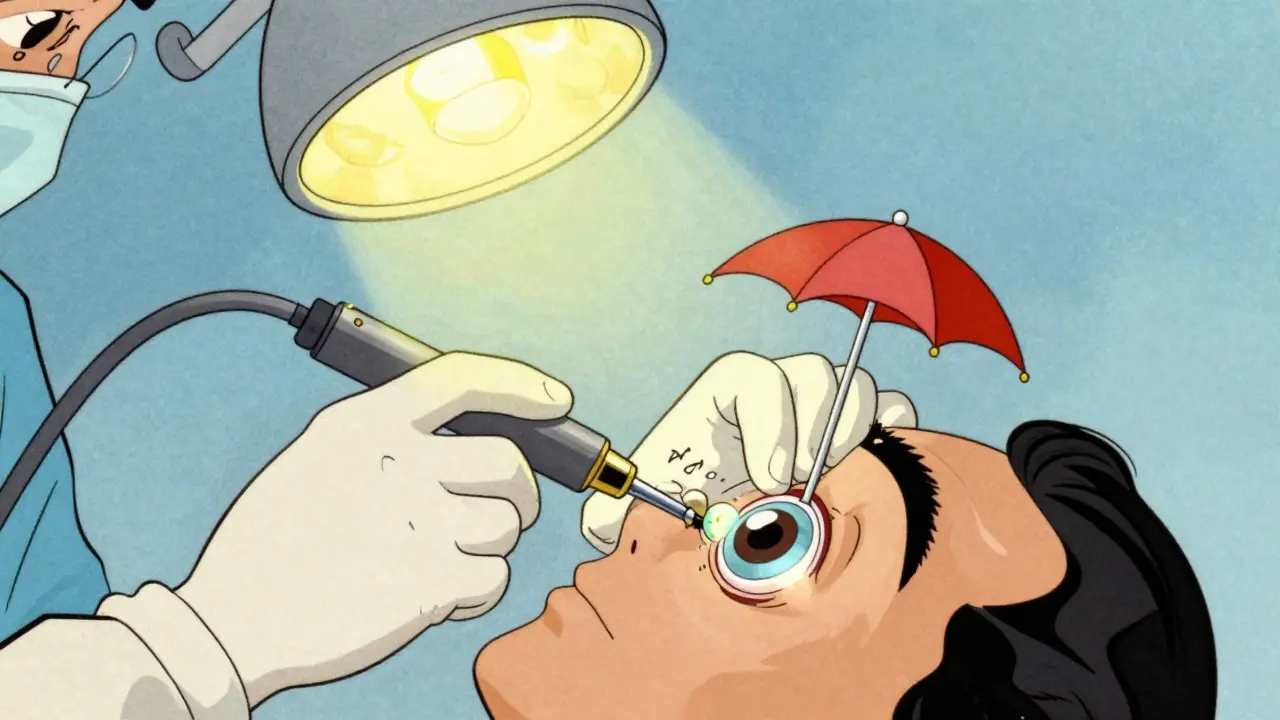
Ninety-five percent of cataract surgeries today use a method called phacoemulsification. Here’s how it works:
- A tiny incision (2.2 to 2.8 mm) is made in the cornea - so small it often doesn’t need stitches.
- An ultrasonic probe is inserted. It vibrates at high speed to break up the cloudy lens into small pieces.
- Those pieces are gently suctioned out.
- A foldable artificial lens (called an intraocular lens or IOL) is inserted through the same tiny opening and unfolds inside the empty lens capsule.
The new lens stays in place permanently. It doesn’t need cleaning. It doesn’t move. It becomes part of your eye. And unlike your natural lens, it won’t cloud again.
What Kind of Lens Will You Get?
Not all lenses are the same. Your surgeon will help you choose based on your lifestyle and budget.
Monofocal lenses are the standard. They’re covered by Medicare and most insurance. They give you sharp distance vision - but you’ll likely still need reading glasses. These cost between $1,500 and $3,000 per eye out-of-pocket if you’re paying cash.
Toric lenses correct astigmatism. If you’ve had trouble seeing clearly at any distance because of an irregularly shaped cornea, this might be a good fit. They cost $2,500 to $4,500 per eye.
Multifocal or trifocal lenses (like Alcon’s PanOptix or Johnson & Johnson’s Tecnis Symfony) are designed to help you see at multiple distances - near, intermediate, and far. About 80-90% of people with these lenses don’t need glasses after surgery. But they’re not covered by insurance. Prices range from $3,000 to $5,000 per eye.
And new options keep coming. In early 2023, Zeiss’s AT LISA tri 839MP IOL got FDA approval - it’s especially good for people who spend a lot of time on computers. These advanced lenses aren’t just about vision - they’re about freedom.
What to Expect After Surgery
Right after surgery, your eye might feel scratchy, sticky, or mildly uncomfortable. That’s normal. Your vision will be blurry at first. Don’t panic. Most people notice a big improvement within 1 to 3 days. Colors seem brighter. Contrast improves. It’s like turning up the brightness on a TV you didn’t realize was dimmed.
But full recovery takes time. The Cleveland Clinic says four weeks. MyHealth Alberta says 3 to 10 weeks. West Boca Eye Center says 6 to 8 weeks. Why the difference? Everyone heals differently. Your body needs time to adjust - not just to the new lens, but to how your brain interprets the new signals coming from your eye.
You’ll get eye drops. Usually:
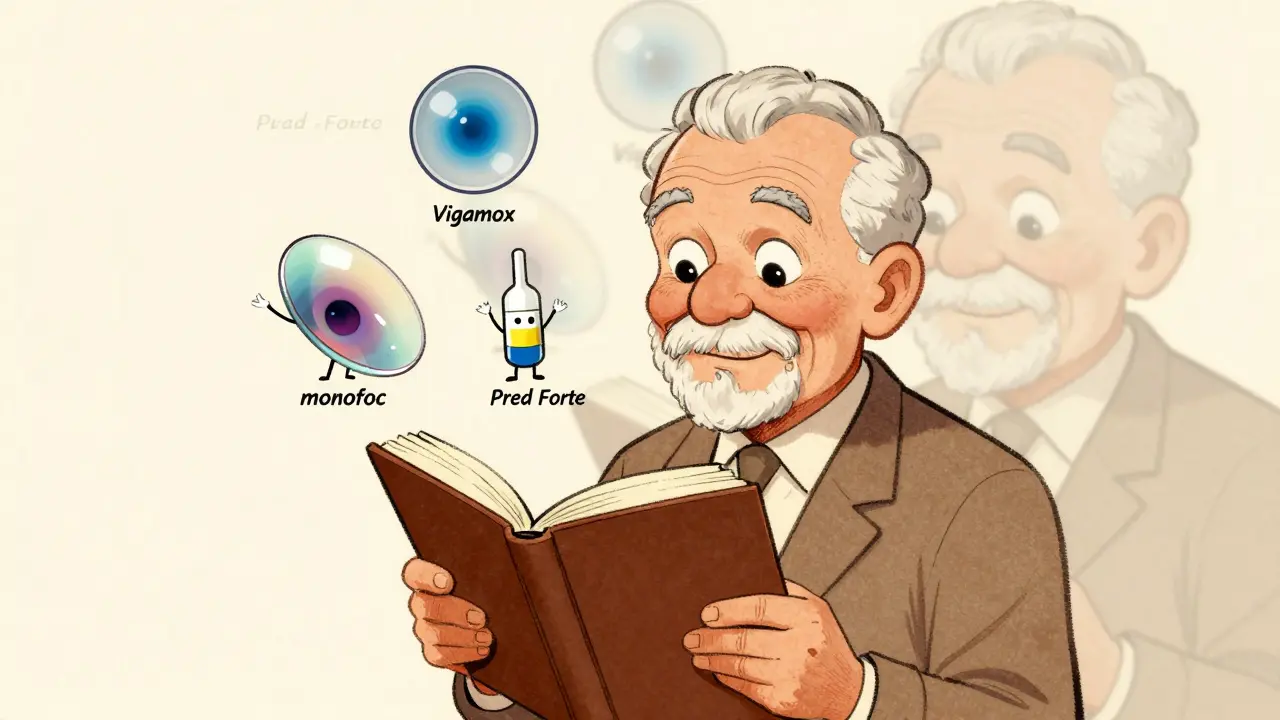
- Antibiotic drops (like Vigamox) - four times a day for a week to prevent infection
- Corticosteroid drops (like Pred Forte) - tapered over four weeks to reduce swelling
And you’ll have rules:
- No driving until your doctor says it’s safe
- No heavy lifting, bending over, or intense exercise for at least two weeks
- No getting water in your eye - no swimming, no showers with water splashing your face
- No rubbing your eye - ever
Can You Still Need Glasses After Surgery?
Yes. And that’s okay.
If you choose a standard monofocal lens, you’ll probably still need reading glasses. That’s not a failure - it’s by design. Monofocal lenses are meant to give you clear distance vision. Reading is a different focal point. You can still read a menu, drive, watch TV. You just need glasses for fine print.
Some people are surprised by how their brain adapts. One Reddit user wrote: “The strangest part was how my brain had to relearn depth perception.” After decades of blurry vision, your brain has learned to guess what things look like. After surgery, it has to relearn how to see sharply. That can take weeks.
What About Complications?
Complications are rare - under 5% of cases. The most common is posterior capsule opacification (PCO). This happens when the membrane that holds the new lens gets cloudy months or years later. It’s not a cataract returning. It’s just scar tissue. It’s easily fixed with a quick, painless laser procedure called YAG capsulotomy. It takes five minutes. No incision. No downtime. And it works in 95% of cases.
Other risks - like infection, bleeding, or retinal detachment - are extremely rare. A 2022 meta-analysis of over 1.2 million cataract surgeries found a safety rate of 99.5%. That’s better than most common surgeries.
Who Doesn’t Benefit as Much?
Not everyone sees 20/20 after surgery. If you have other eye conditions - like advanced glaucoma, diabetic retinopathy, or macular degeneration - your vision may not fully recover. That’s not because the surgery failed. It’s because those conditions damage the retina, the part of the eye that processes images. The cataract surgery fixes the lens. But if the retina is damaged, the image quality still won’t be perfect.
In those cases, vision therapy can help. Specialized exercises - like shifting focus between near and far objects - can train your brain to better interpret the new input. Studies show this reduces eye strain, improves concentration, and even helps with memory and visual processing.
Is It Worth It?
Ask someone who had cataract surgery five years ago. They’ll tell you it was the best decision they ever made. The National Eye Institute estimates 24.4 million Americans over 40 have cataracts. Most of them wait too long. They think it’s just part of getting older. But vision isn’t just about seeing. It’s about independence. It’s about safety. It’s about enjoying the little things - reading a grandchild’s drawing, spotting a pedestrian at dusk, walking without fear of tripping.
Cataract surgery isn’t about fixing a disease. It’s about restoring a life. And with modern lenses, better techniques, and proven safety, it’s one of the most reliable transformations medicine offers.
Can cataracts come back after surgery?
No, cataracts cannot return because the cloudy natural lens is removed and replaced with an artificial one. However, the thin membrane that holds the new lens can sometimes cloud over - a condition called posterior capsule opacification (PCO). This affects 20-30% of patients within five years but is easily treated with a quick, painless laser procedure called YAG capsulotomy.
Is cataract surgery painful?
No. The procedure is done under local anesthesia, so you won’t feel pain. You may feel pressure or a sensation of movement, but not discomfort. Most people describe it as strange, not painful. After surgery, your eye might feel scratchy or mildly irritated for a day or two - similar to having a contact lens in too long.
How long does recovery take?
Most people notice better vision within 1 to 3 days. Full healing takes about 4 to 8 weeks. During this time, you’ll use eye drops, avoid heavy lifting, and protect your eye from water and rubbing. Vision may continue to improve subtly for several months as your brain adjusts to the new lens.
Will I still need glasses after surgery?
It depends on the type of lens you choose. With a standard monofocal lens, you’ll likely need glasses for reading or close work. Toric lenses correct astigmatism but still usually require reading glasses. Multifocal or trifocal lenses can reduce or eliminate the need for glasses - about 80-90% of users don’t need them for daily tasks. Your surgeon will help you pick based on your lifestyle.
Is cataract surgery covered by insurance?
Basic cataract surgery with a standard monofocal lens is covered by Medicare and most private insurance. However, advanced lenses - like toric, multifocal, or trifocal lenses - that correct astigmatism or reduce dependence on glasses are considered elective upgrades. These are not covered and require out-of-pocket payment, typically $2,500 to $4,500 per eye.
Adebayo Muhammad
Let’s be brutally honest: cataracts aren’t a medical issue-they’re a societal failure. We’ve normalized aging like it’s a Netflix subscription you can’t cancel. The lens clouds? Fine. Colors fade? Whatever. Vision degrades? That’s just entropy in action. But here’s the kicker-you’re not just losing sight. You’re losing autonomy. And we treat it like a minor inconvenience instead of the existential threat it is. We medicate depression, but we tell people to ‘just live with blurry vision.’ That’s not wisdom. That’s surrender.
And don’t get me started on the ‘it’s just surgery’ narrative. Surgery is a $10,000 gamble with a 99.5% success rate. Who’s paying? Who’s covered? Who’s left behind? This isn’t healthcare. It’s a tiered system disguised as progress. The rich get multifocal lenses. The poor get monofocal and a prayer. And we call this equity?
It’s not about the lens. It’s about who gets to see clearly-and who doesn’t.
Pranay Roy
Wait-so you’re telling me they’re replacing your natural lens with a piece of plastic? And you’re okay with that? Have you ever heard of the 2018 WHO report on bioengineered implants? They’ve been tracking microchip infiltration in IOLs since 2016. Not the lens itself-no-but the polymer coating. It’s designed to ‘enhance visual processing’-which is code for ‘connects to satellite networks.’ You think they’re fixing cataracts? They’re installing a biometric gateway. And you’re just gonna let them do it? No anesthesia? No consent forms? Just ‘you’ll feel pressure’? That’s not surgery-that’s a data harvest. And they’re calling it ‘routine’.
My cousin had it done in Mumbai. Two weeks later, his smart fridge started sending him recipes for ‘enhanced vision diets.’ Coincidence? I think not.
Joe Prism
Clarity isn’t just about vision. It’s about presence.
My grandfather had surgery last year. Saw his great-granddaughter’s face for the first time. Didn’t cry. Just whispered, ‘You’ve got your mother’s eyes.’
That’s what this is for.
Bridget Verwey
Oh sweet mercy, I just got my second cataract surgery last month and I’m still reeling. I didn’t realize how much I’d been ‘guessing’ at faces. My cat? I thought she was a blurry gray pillow with ears. Turns out she has a little white stripe. A WHOLE STRIPE. And my coffee mug? I thought it was beige. It’s mint green. MINT GREEN. I’ve been drinking out of a ‘beige’ mug for seven years and I didn’t even know I was colorblind. This isn’t medicine. This is a sensory reboot.
Also, the eye drops? I cried during the first one. Not because it hurt. Because it felt like someone poured liquid sunlight into my skull.
Andrew Poulin
Stop overcomplicating this. You need vision? Get the lens replaced. Done. No drama. No conspiracy. No ‘I need to see my grandkid’s freckles’ nonsense. You’re not a poet. You’re a human with a broken part. Fix it. Pay for the upgrade if you want. Don’t whine if you don’t. Surgery isn’t a privilege. It’s a tool. Use it or stay blurry.
Vikas Verma
From a clinical standpoint, the phacoemulsification protocol remains the gold standard for intraocular lens extraction. The biomechanical efficiency of ultrasonic fragmentation coupled with foldable IOL deployment minimizes endothelial cell loss and accelerates postoperative recovery. Furthermore, the incorporation of aspheric and aberration-corrected optics significantly improves contrast sensitivity under low-light conditions. However, patient selection remains paramount-comorbidities such as diabetic retinopathy or AMD necessitate a multidisciplinary approach prior to intervention. Postoperative compliance with topical corticosteroids and antibiotic regimens correlates directly with reduced PCO incidence. Adherence rates below 70% increase risk by 3.2-fold.
Sean Callahan
so i had this weird thing after my surgery like i couldnt sleep because everything was too bright? like my ceiling fan was too loud? and my dog’s eyes were too shiny? like i could see every single eyelash? and i started crying for no reason? like why is the sky blue? why is grass green? why did no one tell me how beautiful everything was? and then i realized-i’d been seeing the world through a dirty window for 20 years and i never even noticed. now i just sit there staring at dust motes in sunlight like its a documentary. it’s not a fix. it’s a revelation. i dont know what to do with this much clarity
Ferdinand Aton
Actually, I read a study in 2021 that said cataracts might be caused by excessive screen time. Not aging. Screen time. So maybe you’re not getting old-you’re just glued to your phone. Just saying.
Jeff Mirisola
I’m 67. Had surgery last year. Monofocal lens. Still need readers. No regrets. My wife says I look younger. Not because I’m younger-but because I finally look awake. I read to my grandkids now. Not ‘kinda’-actually. We do bedtime stories. And for the first time, I see the way their eyebrows scrunch when they’re confused. That’s worth every penny. Even if I had to sell my second car.
Ian Kiplagat
Just had my second eye done. 🌞✨ The world is… louder now. Not in sound. In color. In contrast. In texture. I didn’t know I was living in grayscale until I wasn’t. Also, I cried during the post-op checkup. Not because it hurt. Because I saw my own reflection. And for the first time in years, I recognized myself.
Amina Aminkhuslen
Oh honey, you think this is about vision? Nah. This is about dignity. You don’t want to be the guy who can’t read the microwave. The woman who can’t see the exit sign. The grandpa who misses the moment his grandkid says ‘I love you’ because he’s squinting like a confused owl. Cataract surgery isn’t cosmetic-it’s civilizational. You don’t get to be invisible just because you’re old. The world still needs you to see it. And you? You need to see it before it’s too late.
Tim Hnatko
I’m a quiet guy. I didn’t say much during my surgery. Just nodded. But after? I sat on my porch for an hour just watching the trees. Not because I was bored. Because I’d never seen the individual leaves before. The way the light split through them? Like stained glass. I didn’t cry. I just… breathed. And I realized I’d been holding my breath for 30 years.
Aaron Pace
my eye surgeon gave me a sticker after surgery 🤩 it said ‘I SEE THE WORLD NOW!’ and i cried because i realized i’d never been told how much i’d lost… and how much i could get back
Joe Prism
One thing nobody talks about: after surgery, you don’t just see better. You start remembering things you forgot you saw. The pattern of rain on glass. The way your dog’s nose glistens. The color of your spouse’s eyes when they’re laughing. You didn’t lose vision. You lost attention. Surgery gives it back.