
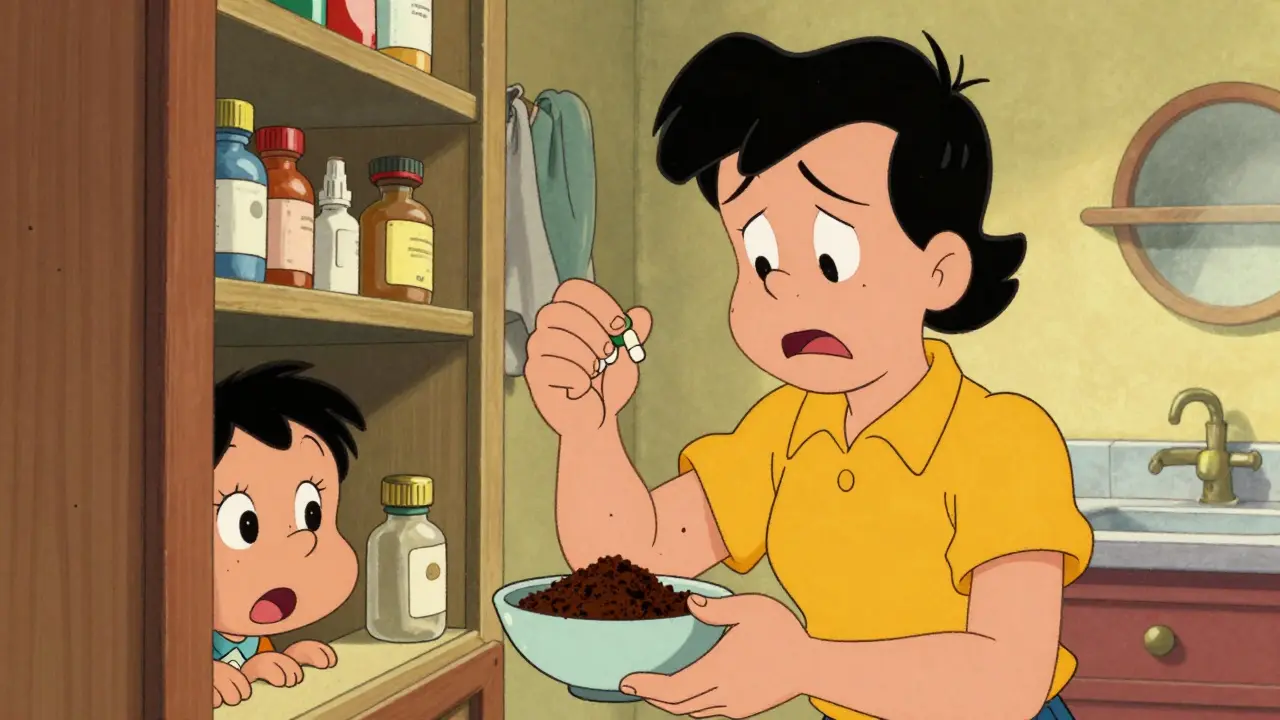
Keeping expired medications in your medicine cabinet isn’t just messy-it’s dangerous. Every year, over 60,000 children end up in emergency rooms after accidentally swallowing pills they found at home. Meanwhile, millions of unused drugs end up in landfills or flushed down toilets, polluting rivers and lakes with chemicals that never fully break down. The good news? You don’t need to be a pharmacist to dispose of expired meds safely. With a few simple steps, you can protect your family, your community, and the environment.
Why You Can’t Just Throw Medications in the Trash
Many people think tossing pills in the garbage is fine. It’s not. Even in sealed bottles, medications can leak, get picked up by curious kids or pets, or be stolen by someone looking for a quick high. The DEA estimates that 23% of diverted prescription opioids come from home medicine cabinets. And if you flush them, you’re adding to a growing problem: 80% of U.S. streams now contain traces of pharmaceuticals, according to the USGS. Some of these compounds-like antidepressants and hormones-can affect fish and other wildlife, even at tiny concentrations.The Gold Standard: Drug Take-Back Programs
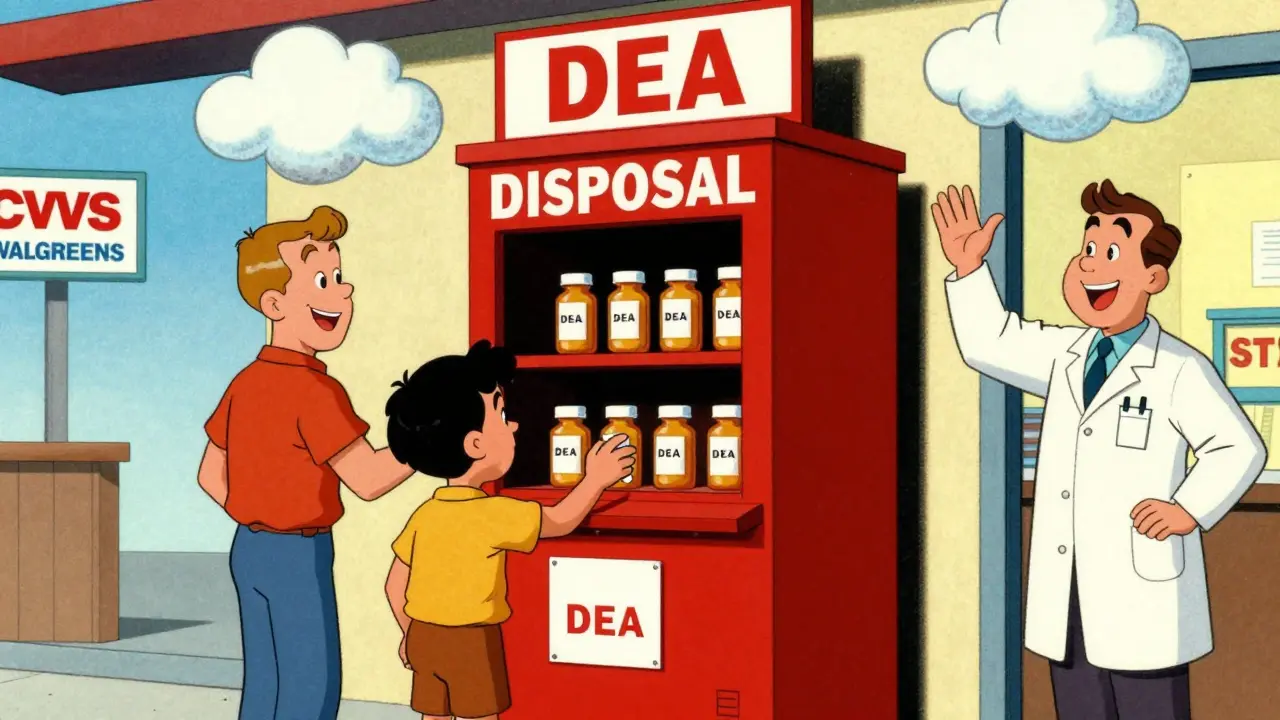
The safest, cleanest way to get rid of expired medications is through a drug take-back program. These are official collection sites run by the DEA, pharmacies, or local law enforcement. They collect pills, patches, liquids, and even syringes, then destroy them under strict environmental controls. Over 14,000 permanent drop-off locations exist across the U.S. today-up from just 127 in 2010. You can find one near you using the DEA’s online locator. Most CVS and Walgreens stores have secure kiosks inside the pharmacy. These accept solid medications like tablets and capsules, but not liquids, inhalers, or needles. Walgreens alone has over 1,400 locations offering this service. CVS has nearly 4,000. If you’re not sure, call ahead. Many of these kiosks are open 24/7, so you can drop off meds anytime. There’s also the National Prescription Drug Take Back Day, held twice a year-in April and October. In October 2022, over 1 million pounds of medication were collected nationwide. It’s a great chance to clean out your cabinet, especially if you’ve been putting it off.What to Do When a Take-Back Site Isn’t Available
If you can’t get to a drop-off location within a week, the FDA and EPA say it’s okay to dispose of most medications at home-but only if you do it right. Here’s the exact step-by-step method they recommend:- Remove the pills from their original bottles. Don’t just toss the bottle. Take the pills out. This prevents someone from finding your name and prescription number on the label.
- Mix them with something unappealing. Use one cup (240ml) of used coffee grounds, cat litter, or dirt. This makes the mixture look and smell gross-so no one will want to dig through it. Don’t use water or soda; they don’t disguise the pills well enough.
- Put the mixture in a sealable container. Use a resealable plastic bag (at least 2-mil thick) or an empty margarine tub. Make sure it won’t leak. For liquids like cough syrup, pour them into the same mixture-no need to dilute them separately.
- Hide your personal info. Use a permanent marker to black out your name, address, prescription number, and pharmacy details on the empty bottle. If you don’t have a marker, peel off the label and throw it in a different trash bag.
- Put it in your regular trash. Not recycling. Not compost. Just toss it with your usual garbage. That’s it.
This method doesn’t destroy the drugs completely, but it makes them unusable and unattractive. Studies show it reduces accidental exposure by 82% compared to leaving pills in the bottle.
Special Cases: Liquids, Inhalers, Needles, and Insulin
Not all medications follow the same rules.- Liquids (like syrups or eye drops): Pour them into the coffee grounds or cat litter mix. Seal them tightly. No need to dilute with water-just make sure the absorbent material soaks it all up.
- Inhalers (like albuterol): Never throw these in the trash. They’re pressurized and can explode in a compactor. Take them to a medical waste facility or a pharmacy that accepts them. Some cities have special collection events for aerosols.
- Needles and sharps: Use a rigid plastic container like an empty laundry detergent bottle (at least 1mm thick). Seal it with heavy-duty tape, label it “SHARPS,” and dispose of it with your trash. Many pharmacies give out free sharps containers-ask at your local Walgreens or CVS.
- Insulin and other temperature-sensitive drugs: These need to be mixed right away with absorbent material to prevent leaks. Store them in the fridge until you’re ready to dispose of them, then follow the standard mixing steps.
What NOT to Do
There are a few dangerous myths floating around. Don’t fall for them.- Don’t crush pills. Unless you’re using a special product like DisposeRx, crushing pills can release dangerous dust into the air. You could inhale it or spread it around your kitchen.
- Don’t flush unless it’s on the FDA’s flush list. Only 15 medications are safe to flush-mostly high-risk opioids like fentanyl patches and oxycodone. The full list is on the FDA’s website. Flushing anything else contributes to water pollution.
- Don’t recycle pill bottles. Most recycling centers don’t accept them because of contamination risk. Keep them for storage, or toss them in the trash after removing labels.
- Don’t give them to someone else. Even if your friend has the same condition, sharing prescriptions is illegal and dangerous.
Tools That Make Disposal Easier
If you want to make this process foolproof, consider a disposal kit. Companies like DisposeRx offer pre-measured packets with absorbent powder and sealing bags. You drop your pills in, add water, shake, and toss. The powder turns the mixture into a gel that can’t be retrieved. These are sold at 76% of U.S. pharmacies and cost between $2.50 and $5 per packet. Some pharmacies also offer mail-back envelopes. You fill them with your meds, seal, and drop in the mailbox. They’re convenient but cost extra. If you’re already paying for a service, go for a drop-off location instead.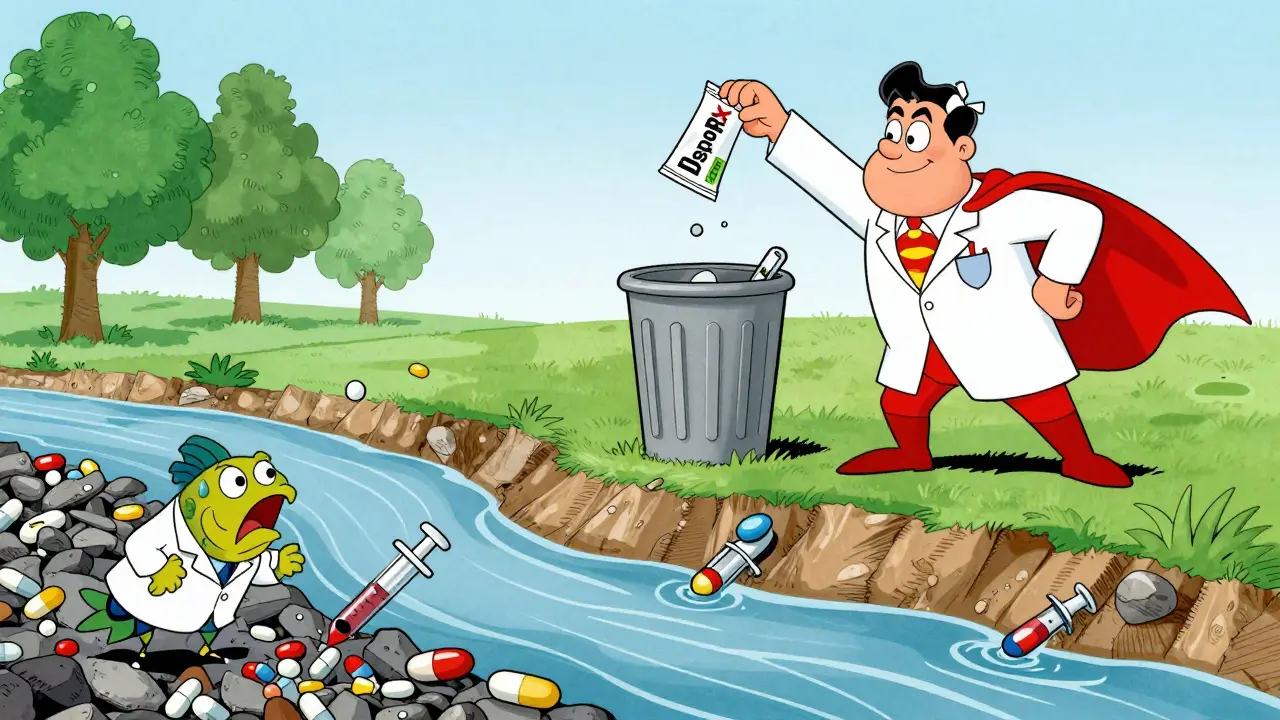
What Happens After You Dispose of Them?
When you drop off meds at a take-back site, they’re collected and burned in high-temperature incinerators. This destroys over 99.8% of the pharmaceuticals, according to DEA lab tests. Home disposal methods aren’t as complete-they still leave behind traces of some drugs in landfill runoff. But they’re far better than leaving them in your cabinet. The EPA estimates that 5.8 billion prescriptions are filled in the U.S. each year. About 15-20% go unused. That’s billions of pills that could end up in the wrong hands or in our water supply. Proper disposal isn’t just personal responsibility-it’s public health.What’s Changing Soon?
In 2025, new federal rules will require every prescription bottle to include disposal instructions right on the label. That means no more guessing. You’ll know exactly what to do with your meds the moment you open the bottle. The FDA is also testing a mobile app that shows real-time locations of nearby take-back sites. It’s in beta with over 12,000 users already. By 2027, experts predict 92% of U.S. households will have easy access to a disposal option-up from 67% today.Final Checklist
Before you toss your expired meds, run through this quick list:- ✅ Are you using a take-back site if one is available within 7 days?
- ✅ Did you remove pills from the original bottle?
- ✅ Did you mix them with coffee grounds, cat litter, or dirt?
- ✅ Did you seal the mixture in a leak-proof container?
- ✅ Did you black out your personal info on the empty bottle?
- ✅ Did you put it in the trash-not the recycling or toilet?
If you answered yes to all of these, you’ve done your part. No one will find your pills. No waterways will be poisoned. And your home will be safer.
Can I flush expired medications down the toilet?
Only if they’re on the FDA’s official flush list-currently only 15 medications, mostly powerful opioids like fentanyl patches and oxycodone. Flushing anything else contributes to water pollution. Most pills should never be flushed. Always check the FDA’s current list before flushing.
What if I don’t have coffee grounds or cat litter?
Use dirt, sawdust, or even powdered laundry detergent. The goal is to make the mixture unappealing and hard to retrieve. Avoid water, soda, or alcohol-they don’t disguise the pills well. If you’re in a pinch, just seal the pills in a plastic bag, black out the label, and throw them in the trash. It’s not ideal, but it’s better than leaving them out.
Can I recycle empty pill bottles?
Most recycling programs don’t accept them because of contamination risk. Even after washing, trace amounts of medication can remain. The safest option is to remove the label, black it out, and toss the bottle in the trash. Some pharmacies have special collection bins for empty bottles-ask your local CVS or Walgreens.
What should I do with expired insulin?
Keep insulin refrigerated until you’re ready to dispose of it. Then, mix it with coffee grounds or cat litter in a sealed container. Don’t pour it down the drain. If you have unused syringes, put them in a rigid plastic container like a detergent bottle, seal it, label it “SHARPS,” and throw it in the trash. Many pharmacies give out free sharps containers.
Is it safe to keep expired meds just in case I need them?
No. Medications lose potency over time and can become harmful. Some, like antibiotics, can turn toxic. Tetracycline, for example, can damage your kidneys if taken after expiration. Keeping old meds increases the risk of accidental overdose, misuse, or confusion-especially for older adults or children. Clear out your cabinet every 6 months.
Christopher King
So let me get this straight - the government tells us to flush pills but only 15 are ‘safe’ to flush? Meanwhile, the same people who run the DEA are the ones who made opioids legal in the first place. They don’t want us to know that every take-back program is just a front for pharmaceutical companies to recycle their expired inventory into new batches. You think they’re cleaning up the environment? Nah. They’re just hiding the evidence so we keep buying more. Wake up, people. This isn’t about safety - it’s about control.
And don’t even get me started on the ‘FDA flush list.’ That’s not a list - it’s a trap. They put the most dangerous drugs on it so we think we’re doing the right thing… while the rest of us are left dumping coffee grounds into plastic bags like peasants. They want us distracted. They want us busy. They don’t want us asking why the pills were expired in the first place.
Who profits when you throw away your meds? The same people who sold them to you. The same people who wrote the prescription. The same people who told you it was ‘safe.’
They’re not here to help you. They’re here to keep you dependent. And the ‘disposal kits’? Those are just fancy subscription boxes for the gullible. Pay $5 to be told what to do with your own medicine. Brilliant.
I’ve stopped taking all prescriptions. I’ve started growing my own herbs. You think that’s crazy? Wait till you see what they’re putting in the water next.
Bailey Adkison
You say not to flush meds unless they’re on the FDA’s flush list but you never link to the list. That’s irresponsible. Also, ‘coffee grounds’ is not a scientifically validated neutralizing agent. The EPA has no official endorsement of this method. And why is cat litter recommended? It’s not regulated for pharmaceutical absorption. This entire guide reads like a blog post written by someone who watched a YouTube video titled ‘How to Disposal Pills Like a Pro.’
Also, ‘2-mil thick bag’ - mil is not a unit of measurement for plastic thickness in the US. It’s mils. And you wrote ‘2-mil’ - that’s grammatically incorrect. It’s 2 mils. You’re not helping. You’re misleading.
And don’t say ‘don’t recycle pill bottles’ without citing the recycling facility’s policy. Some do accept them if washed properly. Your blanket statement is false. You’re spreading misinformation. Fix it.
Harbans Singh
This is actually really helpful. I’m from India and we don’t have take-back programs here - so I’ve been just tossing pills in the trash with the bottle. Now I know to mix them with used tea leaves or soil and remove the label. My grandma used to save old antibiotics ‘just in case’ - I’ll tell her this. Also, the part about insulin and sharps? Super important. My uncle is diabetic and we never knew what to do with the needles. Thanks for breaking it down simply.
One thing - can we do the same with veterinary meds? My dog’s heartworm pills expired last month. Same rules?
Justin James
Let me tell you what they don’t want you to know - the entire drug disposal system is a psyop designed by the pharmaceutical-industrial complex to make you feel like you’re doing something responsible while they continue to poison the planet with synthetic compounds they manufacture in China and ship to Walmart under the guise of ‘medicine.’
The DEA take-back program? It’s a PR stunt. They collect 1 million pounds of pills twice a year - but the FDA approves over 5 billion prescriptions annually. That’s less than 0.04% of the total volume. The rest? They’re still in your cabinet, in your neighbor’s trash, in the groundwater, in the fish you eat, in the rain that falls on your roof.
And the ‘coffee grounds’ method? That’s a Band-Aid on a gunshot wound. You think mixing pills with grounds stops bioaccumulation? No. It just delays it. The chemicals still leach. They still enter the food chain. The EPA knows this. The CDC knows this. But they won’t tell you because if you knew the truth - you’d stop taking pills entirely. And then who would buy them?
They want you to think you’re safe. You’re not. You’re just a participant in a system designed to make you dependent, anxious, and obedient. The pills are the leash. The disposal instructions? The collar.
And now they’re pushing apps and labels on bottles. Next thing you know, your pill bottle will have a QR code that tracks your compliance. They’re not cleaning up the environment. They’re tracking your compliance. Wake up.
They’re not trying to protect you. They’re trying to control you. And if you believe in the system - you’re already part of the problem.
Zabihullah Saleh
It’s funny how we treat medicine like it’s disposable trash when it’s really the most intimate thing we use to interact with our own biology. We swallow these molecules hoping they’ll fix us - and then we throw them away like they mean nothing.
Maybe the real problem isn’t how we dispose of them - it’s why we need so many in the first place. Why are we so sick? Why are our bodies so out of balance that we need a new pill every month?
I’ve started keeping a journal of every medication I take - why I take it, how I feel, whether it’s really helping. I’ve cut out half of mine. Not because I’m anti-medicine - but because I’m pro-awareness.
And yeah, I use take-back bins. But I also wonder - if we designed healthcare around prevention instead of pills, would we even need this guide?
Rick Kimberly
While the guidance provided is generally sound, it is imperative to note that the EPA’s recommended household disposal protocol is not universally applicable across all jurisdictions. Certain states, including California and Washington, have enacted stricter environmental regulations that prohibit the disposal of pharmaceutical waste in municipal solid waste streams regardless of preparation method. Residents in these states are legally obligated to utilize authorized collection programs or mail-back services. Failure to comply may result in civil penalties. Additionally, the term ‘2-mil thick’ is a misnomer; the correct terminology is ‘2 mils’ - a unit of thickness equal to 0.002 inches. Precision in language is not pedantry - it is foundational to public safety.
Katherine Blumhardt
i just throw mine in the trash 😭 i dont even remove the label anymore im so tired of adulting
sagar patel
You say don’t flush but don’t mention that most municipal water systems have no way to filter out pharmaceuticals. The EPA’s own data shows that 80% of rivers contain traces. So your ‘coffee grounds’ method is just a placebo. You think you’re saving the environment? You’re not. You’re just pretending. The real solution is to stop taking pills altogether. The system is broken. You’re just a cog.
Michael Dillon
Wait - you’re telling me I can’t recycle pill bottles? But I’ve been rinsing them out for years! My recycling bin is full of them. Now you’re saying I’ve been doing it wrong? That’s ridiculous. You’re acting like this is some kind of sacred ritual. It’s plastic. It’s clean. Recycle it. Stop making everything so dramatic.
Also, why are we even talking about this? Why not just make all meds non-expirable? Like batteries. They don’t expire. Why do pills? That’s the real question. This whole guide is just distraction. The real problem is the pharmaceutical industry’s monopoly on expiration dates. They make money off you replacing them. It’s a scam.
Gary Hartung
Oh, wonderful. Another ‘how-to’ guide from someone who clearly has never held a real job, never seen a landfill, never met a child who actually swallowed a pill - and yet feels qualified to lecture the entire nation on pharmaceutical waste management. You’ve turned a public health issue into a Pinterest board. ‘Mix with coffee grounds’? That’s not science - that’s a TikTok trend. And you call it ‘the gold standard’? The gold standard is incineration. The rest? It’s performative environmentalism for people who think recycling a plastic bottle makes them a hero.
And the ‘FDA flush list’? You cite it like it’s gospel. But you don’t list it. You don’t link it. You don’t even footnote it. That’s not helpful - that’s lazy. And your checklist? It’s cute. But it’s not policy. It’s a meme. You’ve turned a life-or-death public safety issue into a bullet-pointed Instagram story. Shame.
Ben Harris
So let me get this straight - I have to take my grandma’s blood pressure pills, mix them with cat litter, seal them in a bag, black out the label, then throw them in the trash - but I can’t recycle the bottle because it’s ‘contaminated’? But I washed it! I scrubbed it! I even rinsed it with vinegar! And now you’re telling me I’ve been doing it wrong this whole time? That’s not safety - that’s guilt-tripping.
And why are you assuming everyone has cat litter? I live in an apartment. I don’t have a cat. I don’t even like cats. So now I’m supposed to go buy dirt? From a garden center? What next? Am I supposed to pay for a disposal kit? This isn’t advice - it’s a sales pitch for DisposeRx.
And who wrote this? Some overworked pharmacist who’s never had to clean up after a toddler? I’ve seen my niece open a bottle and dump pills into her mouth like candy. No amount of coffee grounds is going to stop that. The real solution? Lockboxes. Not cat litter.
Sophie Stallkind
Thank you for providing a comprehensive and evidence-based overview of pharmaceutical disposal protocols. The inclusion of jurisdiction-specific considerations, such as state-level regulations and the distinction between solid and liquid formulations, demonstrates a commendable level of diligence. The methodology outlined for household disposal aligns with current guidance issued by the U.S. Food and Drug Administration and the Environmental Protection Agency. I would only suggest the addition of a footnote referencing the 2024 National Academy of Sciences report on pharmaceutical leachate in groundwater, which further validates the necessity of these procedures. This is precisely the kind of public service communication that is too often lacking in digital media.
Linda B.
Of course they say not to flush - because if everyone did, the water treatment plants would have to spend billions upgrading infrastructure… which would mean higher taxes… which would mean the pharmaceutical companies would have to pay more in regulations… which would mean they’d have to lower prices… which would mean they’d stop making the drugs… which would mean people would stop dying from heart disease… which would mean the insurance companies would go bankrupt… which would mean the government would have to provide real healthcare… which would mean the entire system collapses.
So they give you coffee grounds.
And they call it ‘safe.’
They call it ‘responsible.’
They call it ‘a solution.’
It’s not.
It’s a distraction.
And you’re falling for it.
Oluwatosin Ayodele
In Nigeria, we don’t have take-back programs. We don’t even have proper pharmacies in many villages. People just keep expired pills in a box under the bed. Some mix them with food for chickens. Others sell them on the street. I’ve seen a man buy expired antibiotics for his fever because he couldn’t afford the new ones. You talk about ‘pollution’ like it’s a first-world problem. Here, the problem is survival. You can’t tell someone to mix pills with cat litter when they don’t have cats, or electricity, or running water. Your guide is beautiful. But it’s not for us. You’re preaching to the choir - and the choir already has air conditioning and a trash can. We don’t. We just have hope.
Jason Jasper
Thanks for this. I’ve been meaning to clean out my cabinet for months. I didn’t realize how many expired things I had - some from 2018. I’m going to use the coffee grounds method. I’ve got a bag of used grounds from my morning brew. Also, I never knew about the insulin storage tip. My cousin has diabetes and I’ve been worried about her old vials. This is actually useful. I’ll share it with my family.
Christopher King
And now they’re pushing apps to track your disposal habits. Next thing you know, your phone will ping you: ‘You haven’t disposed of your expired meds in 14 days. Your carbon footprint is increasing. Your compliance score is dropping. Would you like to purchase a DisposeRx kit now?’
They’re not helping you. They’re monetizing your fear.
They want you to feel guilty. So you’ll buy more. So you’ll keep taking pills. So you’ll never question why you needed them in the first place.
Wake up.
This isn’t about safety.
This is about control.