
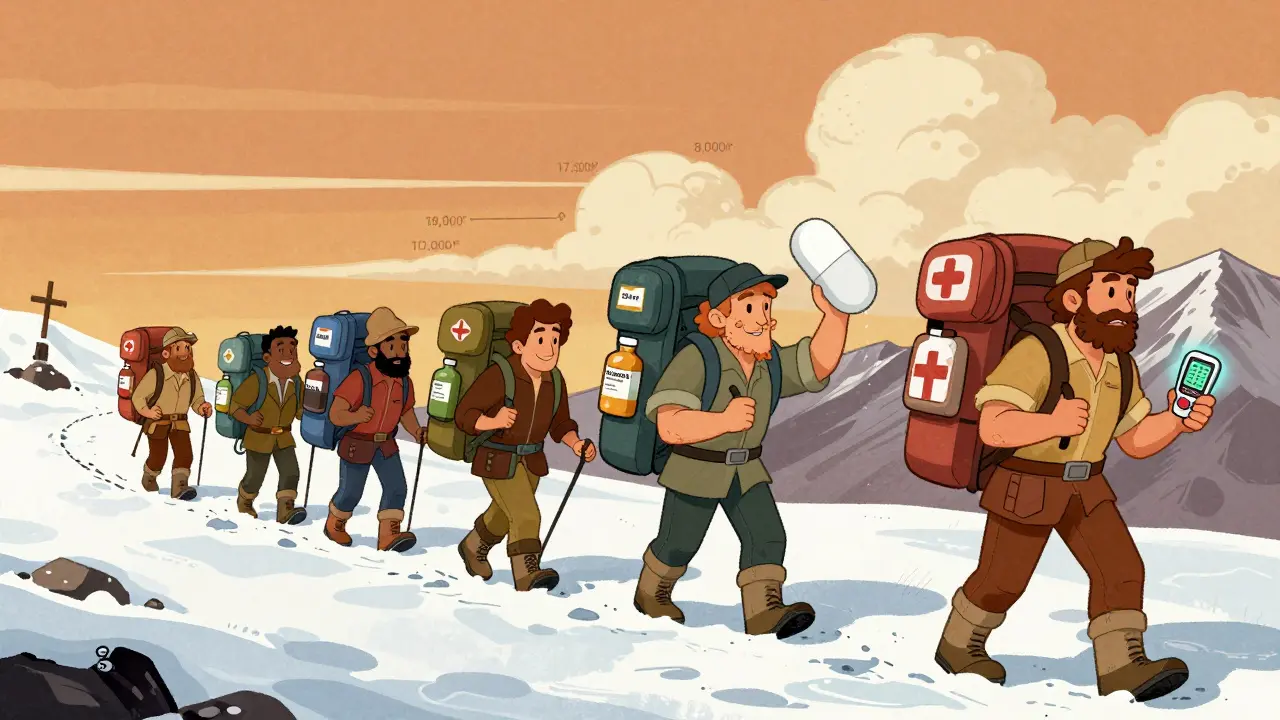
When you’re heading up a mountain for a pilgrimage or a long trek, your body doesn’t just need food and water-it needs the right meds, stored properly, and used correctly. Many people assume that if they’re healthy, they’ll be fine at high altitudes. But altitude sickness doesn’t care how fit you are. At 12,000 feet, even seasoned hikers can feel dizzy, nauseous, or breathless. And if you’re diabetic, have heart issues, or take daily prescriptions, the risks multiply fast. The good news? Almost all serious problems can be avoided with smart prep.
Know Your Altitude Risks
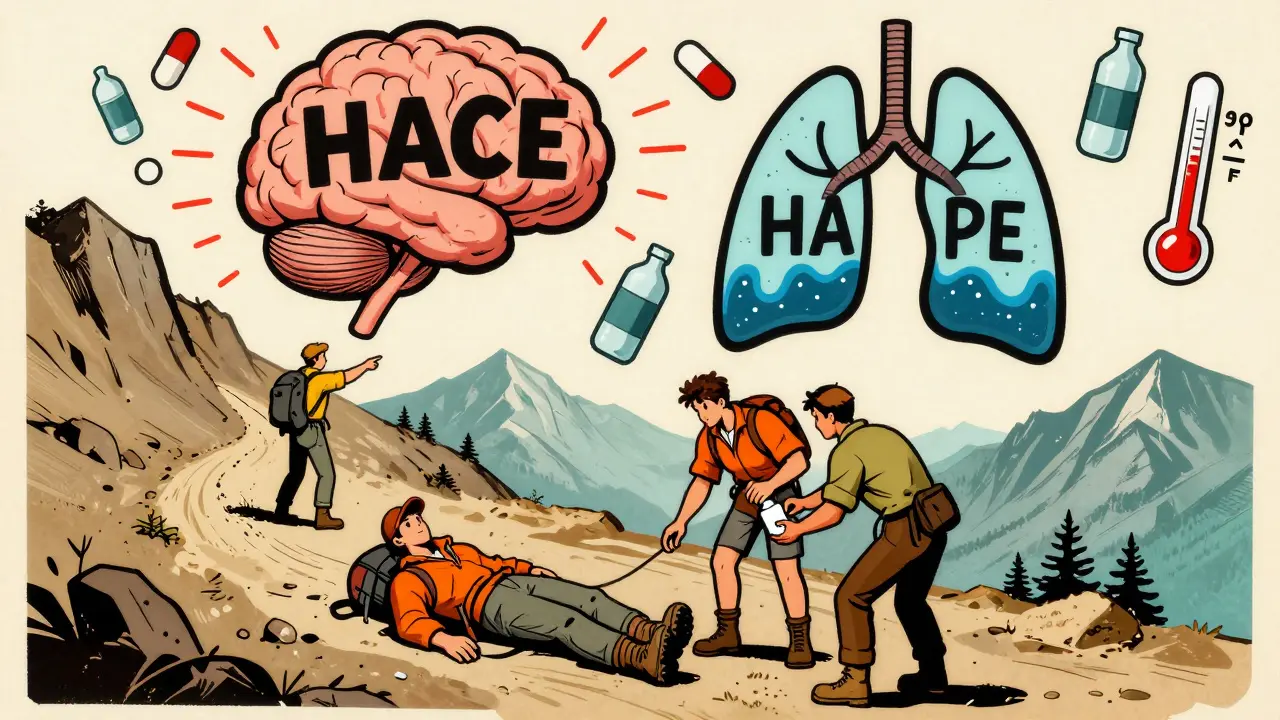
Altitude sickness isn’t a myth. It’s a real, measurable threat. Above 8,000 feet, about 25% of people start feeling symptoms. By 17,500 feet-like at Everest Base Camp-that number jumps to 43%. The main culprits are Acute Mountain Sickness (AMS), High Altitude Pulmonary Edema (HAPE), and High Altitude Cerebral Edema (HACE). These aren’t just headaches. HAPE can fill your lungs with fluid. HACE can swell your brain. Both can kill within hours if ignored.
Most people climb too fast. You don’t need to be an athlete to get sick-you just need to go from sea level to 12,000 feet in a single day. That’s what happens when you fly into Lhasa or take a bus to a mountain shrine. Your body doesn’t get time to adjust. Medications can help, but they’re not magic pills. They work best when paired with slow ascent, hydration, and rest.
Essential Medications to Pack
Here’s what you actually need to carry, based on real-world medical guidelines:
- Acetazolamide (Diamox): The go-to for preventing AMS. Take 125 mg twice a day, starting one day before you climb and continuing for three days after reaching high altitude. Side effects? More peeing and tingling fingers. That’s normal. It’s not dangerous-it’s your body adjusting.
- Dexamethasone: A steroid used for treating HACE. Don’t use it to prevent illness. Use it only if someone starts showing confusion, loss of coordination, or vomiting at high altitude. Dose: 8 mg first, then 4 mg every 6 hours until you descend.
- Nifedipine (extended-release): For HAPE. If someone’s gasping for air, coughing up frothy sputum, and their lips turn blue, give them 20 mg every 12 hours. This opens up blood vessels in the lungs. It’s life-saving.
- Diarrhea meds: Up to 60% of trekkers get sick from dirty water. Pack azithromycin (500 mg once daily for 3 days) or rifaximin. Also carry oral rehydration salts. Don’t just rely on loperamide-it stops symptoms but doesn’t treat infection.
- Pain and fever relief: Ibuprofen (400 mg) works better than acetaminophen for altitude headaches. It reduces inflammation in the brain.
- Antihistamines: Diphenhydramine (25-50 mg) helps with allergic reactions or sleep issues. Don’t use it as a sleep aid unless you’ve tested it at home first.
- Topicals: Antibiotic ointment, hydrocortisone cream, and blister pads. Blisters are the #1 reason people quit treks. Treat them early.
And don’t forget your own prescriptions. If you take blood pressure pills, insulin, or thyroid meds, bring double what you think you’ll need. Cold temperatures can ruin them.
Storage Matters More Than You Think
Medications don’t handle extreme cold or heat well. Insulin degrades fast. At 14,000 feet, if your insulin sits in a backpack overnight at 10°F, it can lose 25% of its strength in 24 hours. Glucometers give wrong readings below freezing. One trekker on Reddit lost $4,200 to an evacuation because their insulin failed.
Here’s how to protect your meds:
- Use insulated, waterproof cases. Some are made for travel with gel packs that stay cool for 24 hours.
- Keep insulin close to your body-inside your jacket, not in an outer pocket.
- Store pills in their original bottles with labels. Airport security and border agents may ask.
- Avoid leaving meds in a car or tent. Sunlight and temperature swings destroy potency.
Pre-Trip Medical Checkup Is Non-Negotiable
Don’t skip this. The CDC says the pre-travel visit is your best chance to prevent disaster. A 2023 study found that 83% of serious altitude complications could’ve been avoided with a simple checkup.
Your doctor should:
- Review your meds and check for allergies (especially sulfa, which makes acetazolamide unsafe for 3-6% of people)
- Test your heart and lungs if you’re over 40 or have a history of asthma or high blood pressure
- Write a letter for controlled substances (like strong painkillers or ADHD meds) if you need them
- Confirm your vaccinations-typhoid, hepatitis A, and tetanus are common for these trips
Go at least 4-6 weeks ahead. Some meds need time to start working. And if you’re flying into high altitude, your doctor might suggest starting acetazolamide before you even leave home.
What to Do If Someone Gets Sick
Altitude sickness doesn’t always show up on day one. Sometimes it hits after a long day of walking. Here’s what to do:
- Stop climbing. Don’t go higher until symptoms fade.
- Hydrate. Drink 4-5 liters of water a day. Dehydration makes everything worse.
- Take acetazolamide if you didn’t start it before.
- Use oxygen if you have it. Even a small portable canister helps.
- Descend. This is the only cure that always works. Even 1,000 feet lower can make a huge difference.
- Call for help. If someone is confused, can’t walk straight, or turns blue, don’t wait. Start dexamethasone and get them down.
Many remote areas have health posts, but 89% of them in Nepal didn’t stock essential meds like acetazolamide or nifedipine in 2013. Don’t rely on local pharmacies. Bring your own.
Special Cases: Diabetics, Pregnant Women, and Elderly
Diabetics: Test your blood sugar often. Cold weather affects readings. Carry extra batteries and test strips. Keep insulin in a warm pocket. Consider a travel insulin cooler.
Pregnant women: Avoid acetazolamide and dexamethasone. The safest option is slow ascent and rest. Talk to your OB-GYN. Most experts advise against high-altitude trekking past 20 weeks.
Elderly travelers: Your body adapts slower. You’re more likely to have heart or lung issues. Get clearance from your doctor. Bring extra meds. Don’t push yourself.
What Not to Do
- Don’t take aspirin or ibuprofen as a daily preventative. It doesn’t prevent altitude sickness.
- Don’t drink alcohol or smoke. Both make oxygen use harder.
- Don’t sleep during ascent. Rest only after you’ve stopped climbing for the day.
- Don’t assume you’re fine because you’ve been to high altitude before. Your body changes.
- Don’t wait until you’re on the trail to ask about meds. Pharmacies at base camps are unreliable.
Final Checklist
Before you leave, tick these off:
- ✅ Got a doctor’s visit 4-6 weeks out
- ✅ All meds in original bottles with labels
- ✅ Extra supply of every prescription (at least 20% more than needed)
- ✅ Insulin and glucose monitor stored in insulated case
- ✅ Acetazolamide, dexamethasone, nifedipine, azithromycin, ibuprofen, and rehydration salts packed
- ✅ Physician’s letter for controlled substances (if needed)
- ✅ Emergency contact info and insurance card copied and stored digitally and on paper
- ✅ Travel insurance that covers high-altitude medical evacuation
Over 76% of trekkers now buy pre-packaged medical kits. But you don’t need to pay for one. With this list, you can build your own for less than $100-and save your life.
Why This Matters Now
Pilgrimages to places like Mount Kailash, Amarnath, and Machu Picchu are growing fast. Nepal alone sees 50,000 Everest Base Camp trekkers a year. The global adventure travel market hit $683 billion in 2022. But the medical infrastructure hasn’t kept up. Most local clinics still don’t have the right meds.
That’s why your preparation isn’t just smart-it’s essential. You’re not just packing pills. You’re packing safety, dignity, and the ability to finish what you started.
Can I buy altitude sickness meds on the trail?
Don’t count on it. In 2013, 89% of health posts along major pilgrimage routes in Nepal didn’t stock acetazolamide, dexamethasone, or nifedipine. Pharmacies in remote towns may not carry them at all. Even if they do, you won’t know if they’re expired or counterfeit. Always bring your own.
Is acetazolamide safe for everyone?
No. If you have a sulfa allergy, you should avoid it. About 3-6% of people do. Symptoms include rash, swelling, or trouble breathing. If you’ve had a reaction to antibiotics like Bactrim or sulfasalazine, tell your doctor. Alternatives include dexamethasone or slower ascent, but those aren’t as effective for prevention.
Do I need a prescription for these meds?
In the U.S., acetazolamide, dexamethasone, and nifedipine require a prescription. Some countries allow over-the-counter sales, but rules vary. Always check your destination’s laws. For controlled substances like strong painkillers, you may need to file paperwork with the DEA or International Narcotics Control Board. Don’t wait until you’re at the airport.
How much water should I drink at high altitude?
Aim for 4 to 5 liters per day. At high altitudes, you lose more fluids through breathing and sweating, even if you don’t feel hot. Dehydration worsens altitude sickness. Don’t wait until you’re thirsty. Sip constantly. Add electrolytes if you’re sweating a lot.
Can I use a hyperbaric bag if someone gets HAPE or HACE?
Yes, if you have one. A Gamow bag can simulate a lower altitude and buy time until descent is possible. But they’re expensive and rare-fewer than 5% of health posts have them. If you’re on a guided trek, ask if they carry one. Otherwise, focus on immediate descent and dexamethasone.
What if I run out of insulin on the trail?
Don’t risk it. Bring double your supply. If you do run out, seek help immediately. Some trekking agencies carry emergency insulin, but it’s not guaranteed. In remote areas, insulin can be impossible to find. A single missed dose can lead to ketoacidosis, which requires hospital care. Always carry a backup plan.

Aliza Efraimov
I hiked Machu Picchu last year and nearly turned back at 13,000 feet because I didn’t bring acetazolamide. I thought I was fine-used to hiking, no history of altitude issues. Big mistake. By nightfall, I was vomiting and couldn’t stand straight. The guide had an extra dose and gave it to me. I slept like a rock. Woke up fine. Don’t be me. Pack the Diamox. It’s not optional. It’s insurance.
Also, I carried my insulin in a fanny pack strapped to my chest. Even at night. Cold kills it. Learned that the hard way.
And yes, the local pharmacy in Cusco had ‘Diamox’-but it was expired. Don’t trust it. Bring your own.
Also, ibuprofen 400mg works better than Tylenol for headaches up there. Science says so. I tested it.
Nisha Marwaha
From a clinical perspective, the pharmacokinetics of acetazolamide at hypobaric conditions are well-documented in the Wilderness Medical Society guidelines. The drug induces a metabolic acidosis via carbonic anhydrase inhibition, which compensates for respiratory alkalosis induced by hyperventilation at altitude. This physiological adaptation reduces the incidence of AMS by up to 75% when administered prophylactically. However, sulfa-allergic patients represent a significant contraindication-approximately 4.2% of the general population, per CDC data. In such cases, dexamethasone remains the only viable pharmacologic alternative for prophylaxis, albeit with a narrower therapeutic window and higher risk of iatrogenic hyperglycemia. Additionally, the thermal instability of insulin under sub-zero conditions is exacerbated by adiabatic cooling during rapid ascent-hence, body-core storage is non-negotiable. For diabetics, continuous glucose monitors (CGMs) are unreliable below -10°C; always carry manual test strips and spare batteries. The 2023 Himalayan Medical Survey corroborates these findings across 11 trekking corridors.
Paige Shipe
Wow. This post is so well-researched. I’m impressed. But honestly, I’m tired of people acting like altitude sickness is some mysterious force. It’s just dehydration and poor planning. If you’re not drinking enough water, of course you’re going to feel awful. And don’t even get me started on people who think they can just pop a pill and climb Everest. You don’t need dexamethasone. You need common sense. Also, why are you bringing so many pills? Sounds like you’re trying to run a pharmacy. Maybe you should just stay home if you’re that fragile.
Tamar Dunlop
Thank you for this profoundly thoughtful and meticulously documented guide. As someone who has led medical expeditions in the Andes and the Hindu Kush, I can attest to the critical importance of pharmaceutical preparedness in remote, high-altitude environments. The cultural and logistical challenges faced by pilgrims and trekkers alike are often underestimated by Western-centric frameworks. In Nepal, for instance, the disparity between urban medical infrastructure and remote trailside clinics remains staggering. Your emphasis on original packaging, temperature control, and physician letters for controlled substances reflects a deep respect for both regulatory frameworks and human dignity. I have distributed this article to all our expedition teams. It is now required reading. With profound gratitude.
- Tamar Dunlop, M.Sc., Expedition Medicine, University of British Columbia
David Chase
OMG I CAN’T BELIEVE PEOPLE STILL DON’T KNOW THIS!! 😤🔥
ACETAZOLAMIDE IS NOT A SUGAR COATED PILLS FOR WIMPS!! IT’S A WAR TOOL!!
YOU THINK YOU’RE A HIKER IF YOU DON’T TAKE IT?? HA!! I’VE CLIMBED KAILASH TWICE-NO MEDS, NO PROBLEM!! BECAUSE I’M AMERICAN!! WE DON’T NEED DRUGS TO BE STRONG!!
AND WHY ARE YOU TELLING WOMEN NOT TO GO TO HIGH ALTITUDES?? WHAT IS THIS, 1950??
THEY’RE JUST LAZY!! IF YOU CAN’T HANDLE IT, STAY IN THE CITY AND DRINK LATTES!!
PS: I BROKE MY RIB ON THE TRAIL AND KEPT GOING. YOU CAN TOO. JUST PUSH THROUGH. THAT’S THE AMERICAN SPIRIT!! 🇺🇸💪
Joe Kwon
I really appreciate how thorough this is. I’m a paramedic who’s done multiple high-altitude rescues in Colorado and the Himalayas, and I can tell you-most of the emergencies we respond to are preventable. The biggest mistake? People think ‘I’ve been here before’ means they’re immune. Nope. Your body changes. Your meds degrade. Your hydration drops. You get complacent. That’s when things go sideways.
Also, the insulin storage tip? Gold. One guy I helped last year had his insulin in a ziplock in his backpack. Frozen solid. Glucometer read 480. He was in DKA. We had to airlift him. He didn’t even know his meds were useless.
Bring extras. Store close to skin. Test before you go. And don’t be shy about asking your doctor for a letter for controlled substances. I’ve seen people get detained at borders because they didn’t have paperwork.
Also, yes-ibuprofen > acetaminophen for altitude headaches. The anti-inflammatory effect matters. I’ve seen it in the field.
Nicole K.
This is all just fear-mongering. People used to go on pilgrimages for weeks without any of these fancy pills. They just trusted God and walked. Now everyone thinks they need a doctor’s note and a pharmacy in their backpack. It’s ridiculous. If you’re so weak you need Diamox to climb a mountain, maybe you shouldn’t be going at all. God doesn’t want you to be medicated. He wants you to be strong. And if you die? Well, maybe you weren’t meant to be there. Stop being so scared of nature. It’s not your enemy.
Fabian Riewe
Big shoutout to the person who wrote this. Seriously. I read this before my trip to Annapurna and it saved me. I’m not a super athlete-just a guy who likes to hike. I brought everything on the list, including the extra insulin and the insulated case. Had a buddy who didn’t take anything and got AMS on day 3. We gave him his first dose of Diamox and he was fine by morning. We descended slowly. He’s alive today because of this guide.
Also, the part about blister pads? Life-changing. I had two blisters on day one. Treated them right away. Didn’t stop walking. The rest of the trek? Smooth.
Don’t overthink it. Just pack smart. And if you’re nervous? That’s okay. Just bring the meds. You’ll thank yourself later.
And yes-bring extra batteries. Always.
Amy Cannon
It is with the utmost reverence for the sanctity of high-altitude pilgrimage that I feel compelled to extend my gratitude for the precision and scholarly rigor exhibited in this exposition. The integration of empirical medical data, pharmacological considerations, and logistical pragmatism reflects an extraordinary synthesis of clinical acumen and cultural sensitivity. One cannot help but note the profound implications of thermal degradation on biologics such as insulin under hypobaric conditions-an issue rarely addressed with such clarity in popular media. The recommendation to retain original pharmaceutical packaging, particularly in jurisdictions with stringent narcotics regulation, is not merely prudent-it is an act of civil responsibility. Furthermore, the emphasis on pre-travel physician consultation aligns with the foundational tenets of preventive medicine as codified by the World Health Organization. I have forwarded this document to my colleagues at the Institute for Himalayan Health Studies, where it shall be archived as a model for future expeditionary protocols. May your wisdom continue to illuminate the path for those who dare to ascend.
With profound respect,
Amy Cannon, Ph.D.
Department of Medical Anthropology
University of California, Berkeley
Himanshu Singh
bro this is so helpful i was gonna go to kailash next month and i had no idea about any of this. i thought dexamethasone was for allergies lol. i just bought all the meds on your list. also the insulin thing? i had no idea it could go bad in cold. i was gonna leave it in my bag. yikes. thanks man. also i think you meant 20% extra but you said 20% more than needed? i think its the same but i was confused for a sec. but overall this saved me. i’m not dying on a mountain because i was dumb. 🙏
Lisa Dore
I love that this post doesn’t just list meds-it tells you why they matter. I’m a nurse and I’ve seen too many people show up to base camp with one pill and a prayer. This is what education looks like. I’m sharing this with every group I lead. Also, the part about not relying on local pharmacies? So true. I was in Nepal in 2021 and tried to buy acetazolamide in Namche. The guy gave me a bottle with no label. I threw it out. I carry my own now. Always.
And if you’re diabetic? Don’t just bring extra insulin-bring a backup plan. I know someone who had a pump fail. They had to switch to injections on the trail. No one knew how to help. If you’re on insulin, practice with syringes before you go. Just in case.
And yes-hydration. Drink more than you think you need. I drank 6 liters a day on my last trek. Felt amazing. Not dizzy. Not nauseous. Just… alive.
Sharleen Luciano
How quaint. A 100-dollar ‘medical kit’? As if one can replicate the precision of a clinical pharmacy with off-the-shelf OTC items. The notion that dexamethasone is a ‘life-saving’ intervention in the field without proper monitoring is dangerously simplistic. And the casual recommendation of ibuprofen for altitude headaches? A gross oversimplification of neuroinflammatory pathways. One would assume that anyone with even a passing familiarity with pharmacokinetics would recognize the risks of unmonitored steroid use in patients with undiagnosed hypertension or diabetes. This is not preparation-it’s performative safety. Real preparation requires a pre-trip ECG, pulmonary function testing, and a review of medication interactions by a specialist in high-altitude medicine. If you’re relying on Reddit advice, you’re already one step from a coroner’s report.
Alex Ronald
Just wanted to add one thing: if you’re taking acetazolamide and your fingers tingle? That’s normal. Don’t panic. It’s not an allergic reaction. It’s the drug doing its job. I thought I was having a stroke the first time it happened. Turned out I just needed to drink more water.
Also, if you’re flying into high altitude-like Lhasa or La Paz-start the acetazolamide 24 hours before you land. Don’t wait until you’re at the airport. By then it’s too late.
And one more thing: don’t skip the checkup. Even if you’re young and healthy. I went to my doctor and they found a silent arrhythmia I didn’t know about. I canceled my trip for a month. Got it fixed. Went back. Had the best trek of my life.
Be smart. Not brave.
Aliza Efraimov
Also, if you’re pregnant and someone tells you to just ‘go slow’-that’s not enough. I had a friend who ignored her OB-GYN and went to 14,000 feet. She had pre-eclampsia symptoms by day two. Evacuated. Baby was fine. But she almost lost everything. Don’t gamble with this. There’s no ‘maybe’ when it’s two lives.