
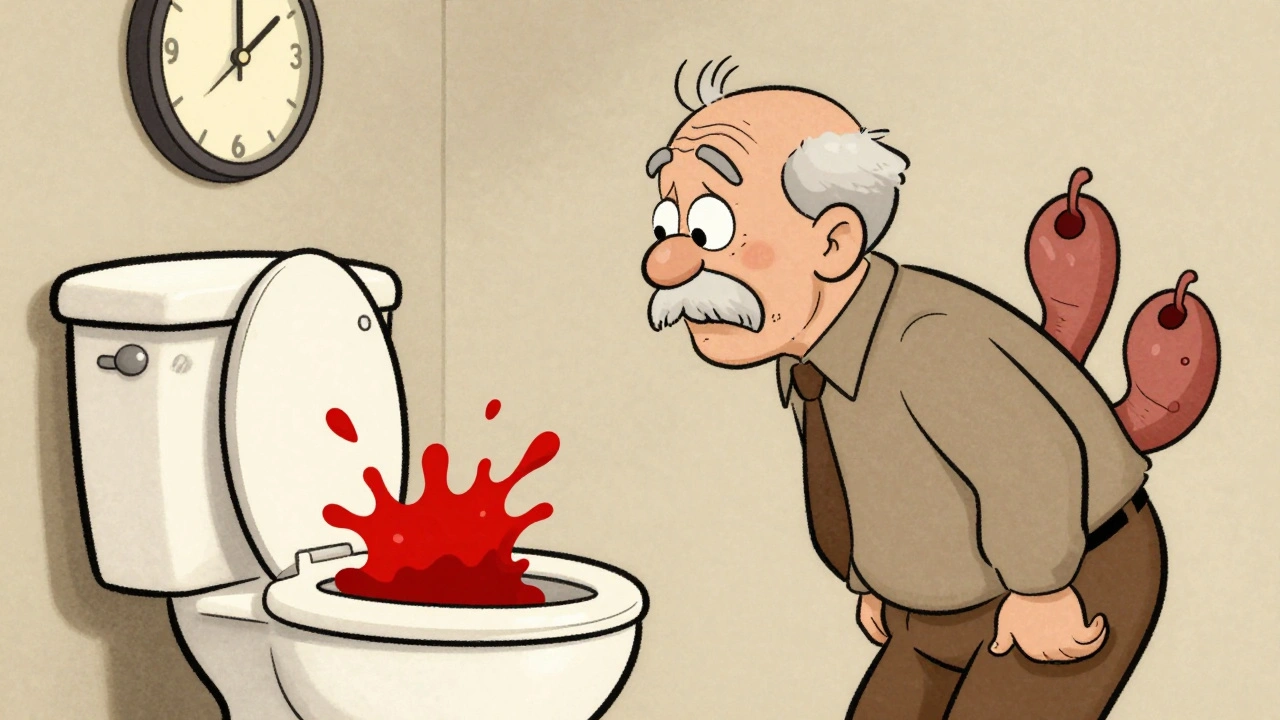
What Is Lower GI Bleeding?
Lower gastrointestinal (GI) bleeding means blood is coming from somewhere in your colon, rectum, or anus. It’s not the same as vomiting blood-that’s upper GI. Lower GI bleeding usually shows up as bright red or maroon blood in your stool, sometimes mixed in, sometimes on the toilet paper, or even just dripping after a bowel movement. You might not feel pain, which can make it confusing. Some people think it’s just hemorrhoids. But it could be something more serious like diverticula or angiodysplasia.
Every year, about 20 to 27 people out of every 100,000 experience this kind of bleeding. It’s rare under age 50, but after 60, the risk goes up fast. Most cases stop on their own, but some need urgent care. The two biggest causes? Diverticula and angiodysplasia. Together, they make up more than half of all serious lower GI bleeds.
Diverticula: The Silent Bleeder
Diverticula are small pouches that stick out from the wall of your colon. They’re common-nearly half of people over 60 have them. Most never cause problems. But sometimes, a tiny blood vessel runs right over the top of one of these pouches. When it gets weak or tears, it bleeds hard and fast. This is diverticular bleeding.
What makes it scary is how sudden it is. One minute you’re fine. The next, you’re seeing a lot of blood in the toilet. There’s usually no pain, no cramping, no fever. That’s different from diverticulitis, which is an infection and does hurt. Diverticular bleeding is just a broken vessel. About 80% of the time, it stops by itself. But if you’re losing a lot of blood, you can get dizzy, weak, or even pass out.
Doctors know it’s diverticula when the bleeding is heavy, painless, and starts suddenly. Colonoscopy can find the exact spot-often in the left side of the colon. Once found, they can treat it during the same procedure using heat or clips. But even after treatment, about 1 in 4 people will bleed again within a year.
Angiodysplasia: The Slow Leak
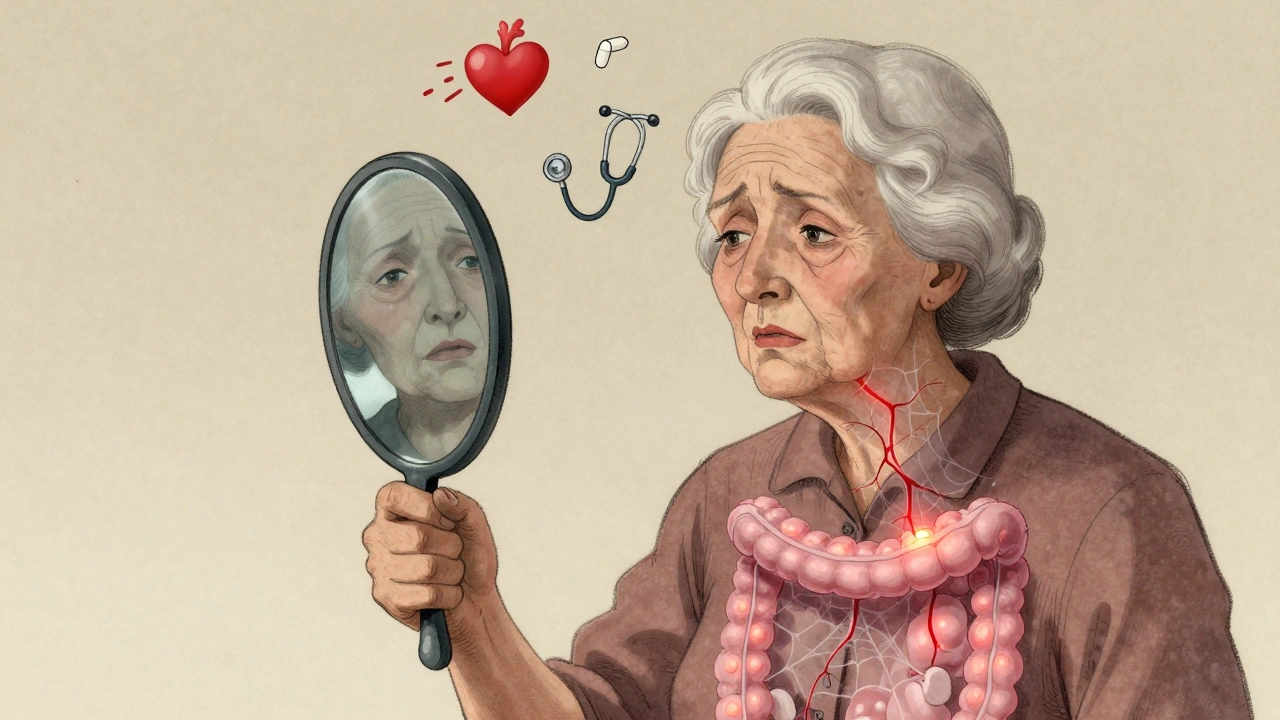
Angiodysplasia is different. It’s not a pouch. It’s a tangled mess of small blood vessels in the colon lining. These vessels grow bigger over time, especially as you age. They’re most common on the right side of the colon, near the cecum. And they’re sneaky.
Instead of one big gush, angiodysplasia leaks slowly. You might not even notice blood in your stool. Instead, you feel tired all the time. Your skin looks pale. Your heart races when you climb stairs. That’s because you’re slowly losing iron-your body’s making less hemoglobin. Many patients are diagnosed with anemia first, then later find out it’s from angiodysplasia.
It’s mostly seen in people over 65. The average age is 72. And here’s something important: if you have a bad heart valve, especially aortic stenosis, your risk goes up. Why? The turbulent blood flow damages a clotting protein called von Willebrand factor. That makes it harder for your blood to stop bleeding, even from tiny vessels.
Colonoscopy finds these lesions as red, spiderweb-like spots. But they’re easy to miss. That’s why some people have three or four negative colonoscopies before the real culprit is spotted. New AI tools during colonoscopy are helping-detecting angiodysplasia 35% better than before.
How Doctors Figure Out What’s Causing the Bleed
When you show up with blood in your stool, the first thing the ER team does is check your vitals. Are you dizzy? Is your heart racing? Is your blood pressure low? These signs tell them how bad the bleed is.
They’ll run a blood test to check your hemoglobin. If it’s below 10 g/dL, you’ve lost a lot of blood. They’ll also check your clotting numbers and do a type and crossmatch in case you need a transfusion.
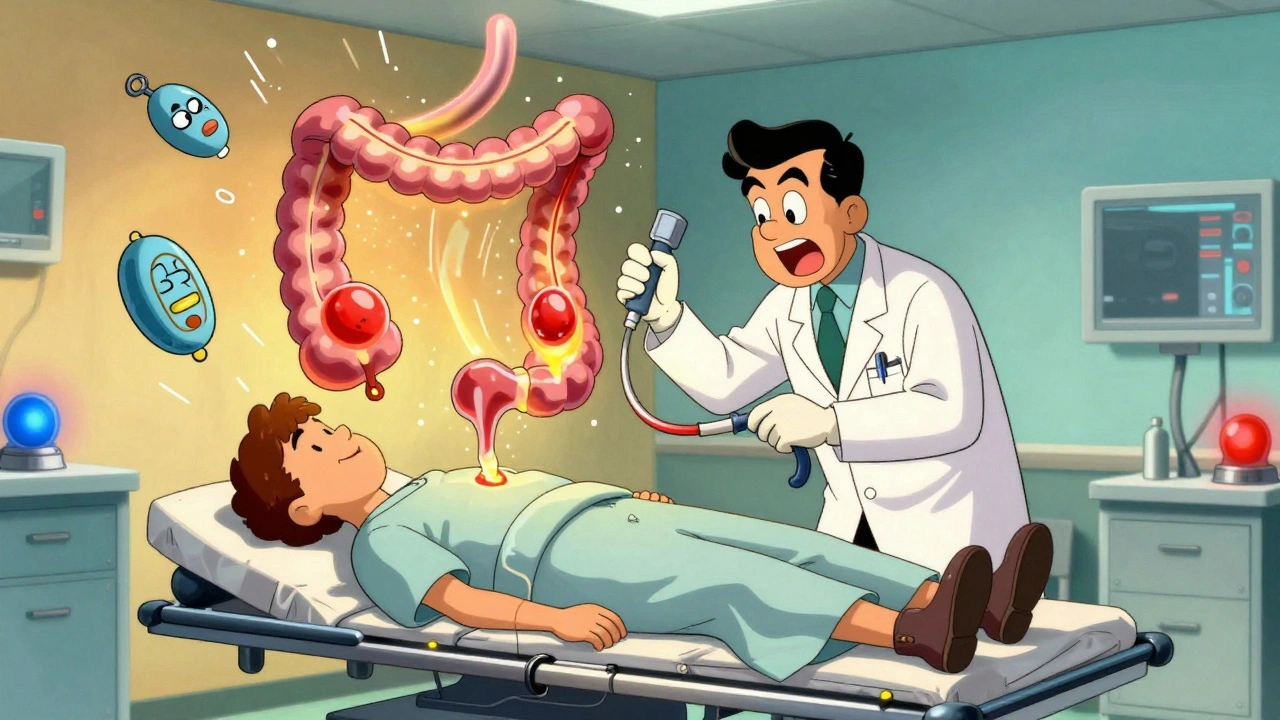
The gold standard test? Colonoscopy. And it needs to be done fast-ideally within 24 hours. Studies show doing it early cuts death risk by 26%. You don’t need a perfect bowel prep. In emergencies, doctors give you IV fluids and a drug called erythromycin to clear out the colon faster.
If the colonoscopy doesn’t find anything, that’s when things get trickier. That’s called obscure GI bleeding. Next steps? A CT angiogram. It can spot active bleeding if it’s leaking more than half a milliliter per minute. It’s great for finding the source when the colon looks clean.
If that’s still negative, capsule endoscopy might be next. You swallow a tiny camera that takes pictures as it moves through your small intestine. It finds the cause in about 6 out of 10 cases. But it’s not perfect. In 15% of cases, the capsule gets stuck if there’s a hidden narrowing. That’s why some doctors wait until after device-assisted enteroscopy, which lets them go deeper but needs special training.
Treatment: What Happens After Diagnosis
For diverticular bleeding, most people don’t need surgery. Fluids, rest, and maybe a blood transfusion are enough. If they find the bleeding spot during colonoscopy, they use a tiny probe to burn it (thermal coagulation) or inject epinephrine to shrink the vessel. Success rate? 85-90%. But rebleeding happens in 20-30% of cases. If it keeps coming back and it’s in one section of the colon, removing that piece surgically can cure it.
Angiodysplasia is harder to fix permanently. The go-to treatment is argon plasma coagulation (APC)-a non-contact heat method that seals the vessels. It works right away in 80-90% of cases. But the vessels can regrow. About 1 in 3 people bleed again within a year or two.
For those who keep rebleeding, there are medications. Thalidomide, taken daily, has been shown in trials to cut transfusion needs by 70%. It’s not for everyone-it has side effects-but for people with frequent bleeds, it’s a game-changer. Octreotide, a shot given three times a day, also helps reduce bleeding in many patients.
For the rare cases where everything else fails, surgery is an option. If the angiodysplasia is in the right colon, removing the right side of the colon (right hemicolectomy) often stops the bleeding for good.
What You Should Know About Long-Term Outlook
Most people recover well. The 30-day death rate for diverticular bleeding is 10-22%, but that’s mostly because patients are older and have other health problems like heart disease or kidney failure-not because the bleed itself kills them.
Angiodysplasia has lower death rates-5-10%-but it’s more of a long-term nuisance. People with recurrent bleeding often end up in the hospital multiple times. One patient survey found that it takes an average of 18 months to get the right diagnosis. That’s a long time to feel tired, weak, and anxious.
Five-year survival is good: about 78% for diverticular bleeding, 82% for angiodysplasia. The key? Managing the underlying conditions. If you have heart disease, control it. If you’re anemic, take iron. If you keep bleeding, don’t ignore it. New tools like AI-enhanced colonoscopy and better endoscopic clips are making detection and treatment faster and more accurate.
When to Call Your Doctor
You don’t need to panic every time you see a little blood. But if you notice any of these, get checked:
- Bright red or maroon blood in your stool that’s new or getting worse
- Feeling dizzy, lightheaded, or short of breath with mild activity
- Unexplained fatigue or pale skin that won’t go away
- History of diverticula or heart valve problems and new bleeding
Don’t wait for it to get worse. Early diagnosis saves lives-and prevents repeat hospital visits.

Christian Landry
so i saw a little blood after pooping and thought it was hemorrhoids... turns out i had angiodysplasia. no pain, just tired all the time. took 3 colonoscopies to catch it. 😅
Taya Rtichsheva
diverticula bleeding is basically the colon’s way of saying i’m too old for this shit
Guylaine Lapointe
I find it alarming how many people dismiss bright red blood as ‘just hemorrhoids.’ This is not a ‘wait and see’ situation. If you’re over 60 and bleeding, get a colonoscopy within 24 hours-no excuses. Delaying care isn’t bravery; it’s negligence. The data is clear: early intervention reduces mortality by 26%. This isn’t speculation-it’s clinical fact. And if you’re anemic without a known cause? That’s a red flag, not a nuisance.
Suzanne Johnston
It’s fascinating how angiodysplasia is so tied to cardiovascular health. The von Willebrand factor degradation due to turbulent flow in aortic stenosis... it’s like the body’s own plumbing system is slowly rusting from the inside. We treat the bleed, but rarely the root. Maybe we need to start thinking of GI bleeds as systemic events, not isolated incidents.
Katie Harrison
I’ve had two episodes of diverticular bleeding. Both times, I was in the ER thinking I was dying. No pain. Just... blood. Everywhere. The doctors were calm. I was not. They used clips during the colonoscopy. It felt like magic. But I still panic every time I see a speck of red. I’ve been told rebleeding is common. I don’t want to be one of those 1 in 4.
Jennifer Blandford
I just want to say thank you to whoever wrote this. I’ve been feeling like garbage for months-fatigue, pale, dizzy-and no one could figure it out. My doctor finally ordered a capsule endoscopy after three negative colonoscopies. Turns out, angiodysplasia. I’m on thalidomide now. It’s scary but it’s working. You’re not alone. 💛
Shubham Mathur
in india most people dont even know what diverticula means they just think its constipation or spicy food problem. i told my uncle to get checked after he bled and he said i dont have time for hospital. now he's in ICU. dont be like him
Graham Abbas
I’ve been reading about this for weeks. The real tragedy isn’t the bleeding-it’s how long it takes to diagnose. One woman I read about had seven negative colonoscopies over four years. Seven. And each time, they said, ‘Nothing found.’ But the bleeding kept coming. AI is a game-changer, but it shouldn’t take seven tries to save someone’s life. We need better training. We need better protocols.
Steve Sullivan
i got my first colonoscopy at 58 bc my mom had diverticulosis. they found 12 diverticula and one tiny bleed spot. clamped it right away. now i take iron daily. also started walking 10k steps a day. life’s too short to ignore your colon. 🤘
ian septian
If you bleed, get checked. Fast.
George Taylor
This article is so sanitized. ‘Most cases stop on their own’? That’s the same thing they told my aunt before she lost 4 units of blood and ended up in the ICU for a week. They didn’t even mention how often these ‘self-limiting’ bleeds lead to emergency surgeries because no one took it seriously. And don’t get me started on the fact that AI tools are still being rolled out in 20% of hospitals. This isn’t medicine-it’s a lottery.
Mona Schmidt
To anyone reading this and thinking, ‘I’ll wait until it happens again’-please don’t. I’m a nurse, and I’ve seen too many patients come in too late. Angiodysplasia doesn’t announce itself with pain. It whispers. It steals your energy, your color, your breath. By the time you notice, you’re already anemic. Get tested. Even if you’re ‘fine.’ Your future self will thank you. And if you’re a doctor reading this-please, if someone’s hemoglobin is dropping and you can’t find the cause, don’t stop at the colon. Look deeper. The small intestine is listening.