
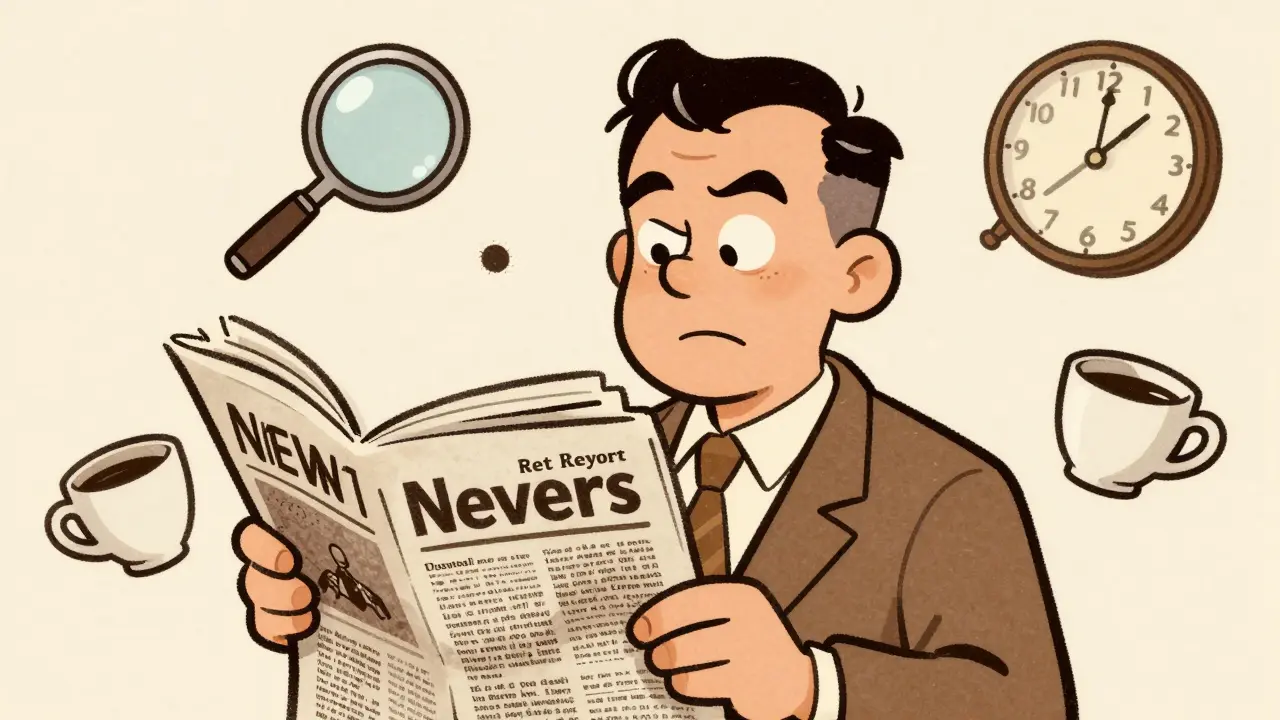
By the time you hit your mid-40s, you might start holding your phone farther away to read text. Or you squint at the menu at dinner. Maybe you’ve noticed your eyes get tired faster when reading or working on the computer. This isn’t just bad lighting or stress-it’s presbyopia. It’s not a disease. It’s not something you did wrong. It’s simply what happens to every human being as they age.
What Exactly Is Presbyopia?
Presbyopia is the gradual loss of your eye’s ability to focus on close objects. It’s caused by the natural lens inside your eye becoming stiffer and less flexible over time. When you were younger, that lens could easily change shape to bring nearby things-like a book, your phone, or your coffee cup-into sharp focus. As you age, the lens thickens and hardens, like an onion adding layers. It can’t bend light properly anymore, so close-up images blur. This isn’t the same as being farsighted. Farsightedness comes from the shape of your eyeball. Presbyopia comes from the lens itself. And unlike other vision problems, you can’t prevent it. No eye exercises, no special diet, no supplements will stop it. As Dr. Emily Chew from the National Eye Institute says, “It’s as inevitable as gray hair.” By age 45, nearly everyone starts noticing symptoms. By 60, most people need +2.50 to +3.00 diopters of correction just to read a newspaper. That’s a big jump from the +1.00 most people need at 45. Your near point-the closest distance your eyes can focus-moves from about 7 centimeters at age 15 to over 100 centimeters by age 60. That means you’re holding things at arm’s length just to see them clearly.How Reading Glasses Fix the Problem
Reading glasses are the simplest, most common fix. They’re convex lenses that add focusing power to help your stiff lens catch up. They don’t cure presbyopia-they compensate for it. Over-the-counter reading glasses come in strengths from +0.75 to +3.50 diopters, usually in 0.25 increments. You can find them at Walmart, CVS, or Amazon for as little as $5.99. They’re convenient, cheap, and work great for occasional use-like reading a recipe or checking your text messages. But here’s the catch: they’re not customized. If you need +1.75 in one eye and +2.00 in the other, buying a pair labeled +1.75 won’t help your stronger eye. About 35% of people who buy OTC readers end up with the wrong strength, which can cause headaches, eye strain, or blurry vision. Prescription reading glasses are made for your exact needs. Your eye doctor will measure your pupillary distance (the space between your pupils), your dominant eye, and how your glasses sit on your face. This ensures the lenses are perfectly aligned for your vision. Prescription readers cost $150-$400, depending on lens material and frame.What About Progressive Lenses?
If you already wear glasses for distance vision, reading glasses won’t cut it. You’ll be constantly taking them off and putting them back on. That’s where progressive lenses come in. Progressive lenses are single lenses with three zones: distance at the top, intermediate in the middle (for computer screens), and near at the bottom (for reading). They look like regular glasses-no visible lines like bifocals. But they’re complex. The transition between zones is gradual, and the design must match your frame’s shape, how far your eyes sit from the lens, and even the angle your glasses tilt on your nose. They’re not perfect. About 25% of first-time wearers report peripheral distortion-things look warped at the edges. It takes 2-4 weeks to adapt. Some people never fully adjust. But for many, especially those who work on computers or drive often, they’re the best solution. Brands like EssilorLuxottica’s Eyezen Progressive 2.0 have widened the near zone by 30% based on real user data, making them easier to use. Progressive lenses cost $250-$450, depending on the brand and lens technology. Online retailers like Warby Parker now offer “progressive trial kits” so you can test them at home before committing.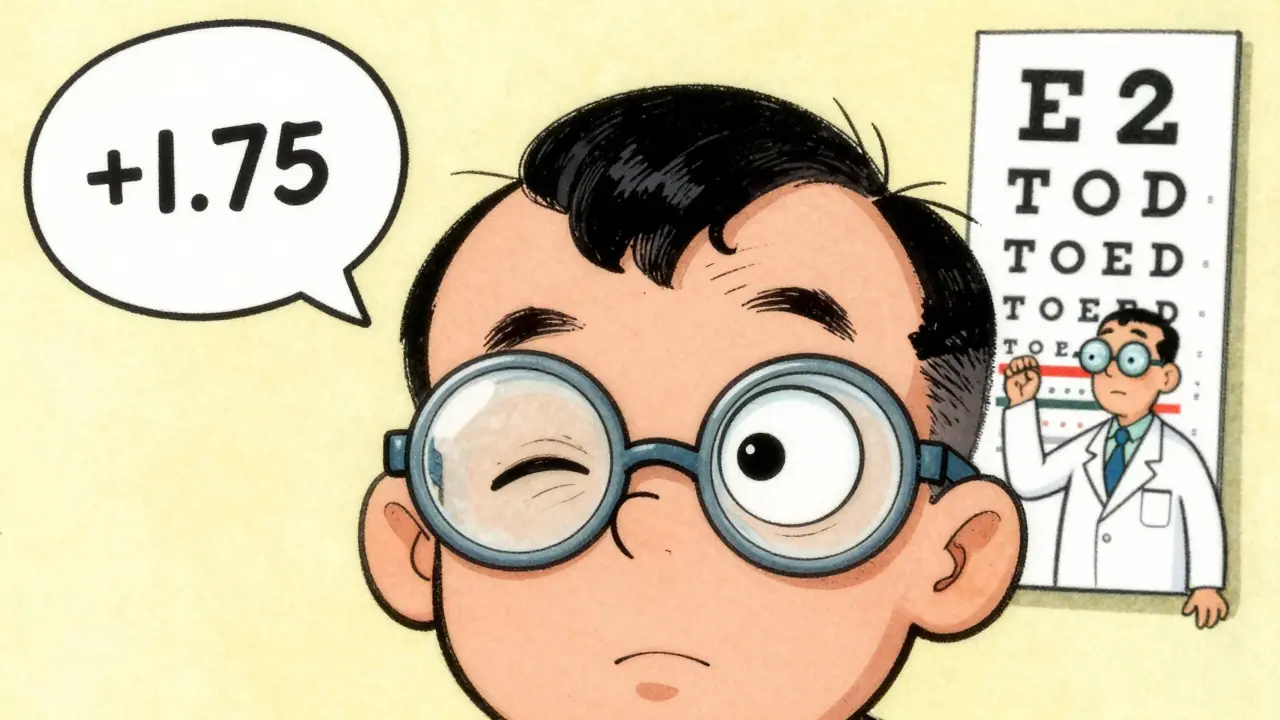
Other Options: Contacts, Surgery, and New Tech
Some people prefer contact lenses. Monovision contacts correct one eye for distance and the other for near vision. About 80% of users adapt well, but 15% lose depth perception, making tasks like parking or climbing stairs trickier. Surgery is another path. LASIK monovision reshapes the cornea to mimic monovision contacts. It costs $2,000-$4,000 per eye, and 85% of patients report satisfaction. But 35% get dry eyes, and 10-15% need a follow-up procedure within five years. Refractive lens exchange replaces your natural lens with an artificial multifocal one-similar to cataract surgery. It’s permanent. Costs range from $3,500 to $5,000 per eye. You’ll likely see better near vision without glasses, but 25% experience halos at night, and 15% notice reduced contrast sensitivity in low light. Newer options are emerging. In 2023, Johnson & Johnson’s Acuvue Oasys Multifocal contact lenses showed 89% success in clinical trials. Presbia’s Flexivue Microlens-a tiny implant placed in the cornea-gave 78% of users 20/25 near vision after a year. Researchers are even testing eye drops like VP-025 that temporarily improve focusing power for up to six hours. These aren’t mainstream yet, but they’re coming.What Experts Say and What You Should Do
The American Academy of Ophthalmology recommends a comprehensive eye exam at age 40. That’s when they start checking for presbyopia, glaucoma, macular degeneration, and other age-related changes. Don’t wait until you’re struggling to read your grandchild’s birthday card. Your eye doctor will use cycloplegic refraction-drops that temporarily paralyze the focusing muscle-to get the most accurate measurement. Without it, they might underestimate your needed correction by 0.25 to 0.50 diopters. That might not sound like much, but it’s enough to make your eyes tire out faster. Dr. Paul Ajamian from Mount Sinai puts it plainly: “Presbyopia is not a disease. It’s a natural consequence of aging. Everyone gets it. The goal isn’t to fight it-it’s to manage it well.”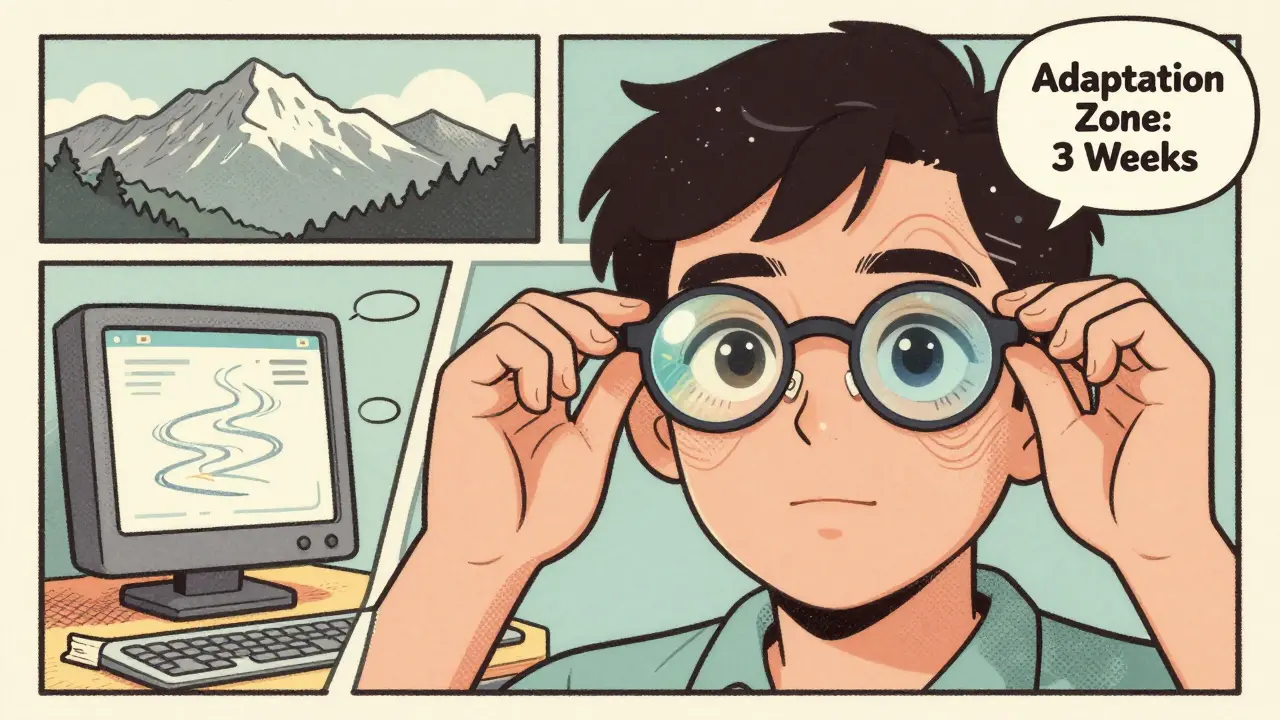
Real People, Real Experiences
On Reddit, users share stories like: “First noticed I couldn’t read the microwave clock at 42. Bought $8 readers. Now I need +2.50 and they’re still not enough.” Or: “Took three weeks to get used to progressives. Felt like I was walking through a funhouse. Then one day, I just… didn’t notice anymore. Now I can’t go back.” Amazon reviews for cheap readers are mixed. 4.1 stars overall, but 22% of one-star reviews say they gave them headaches. Trustpilot reviews for Zenni Optical’s progressives show 4.3 stars, with many praising affordability-but 28% of negative reviews mention headaches during the adjustment period. One graphic designer in Seattle switched to occupational progressives with a 14mm corridor length. She says it eliminated the strain from switching between her monitor and printed documents. “I used to have to stand up, walk to the printer, then sit back down and readjust. Now I just glance down. It’s that simple.”Choosing What’s Right for You
Ask yourself: How often do you need near vision? - If you only read books or check your phone occasionally → over-the-counter readers are fine. Just don’t buy the same strength for both eyes if your prescription is different. - If you wear distance glasses and switch between computer, reading, and driving → progressives are worth the investment and adjustment period. - If you’re active, hate wearing glasses, and want freedom → consider monovision contacts or LASIK monovision. But be honest about your tolerance for depth perception loss. - If you’re over 55 and already have early cataracts → refractive lens exchange might be the smartest long-term move. You kill two birds with one stone. Don’t rush. Try one solution for a few weeks. If it doesn’t feel right, talk to your eye doctor. There’s no single best answer-only the best answer for you.The Bigger Picture
By 2030, 2.1 billion people worldwide will have presbyopia. That’s more than the entire population of India. It’s the most common vision issue on the planet. The global market for corrections is growing fast-$14.2 billion in 2022, and expected to hit $25 billion by 2030. In the U.S., 38% of that market is here. Optical chains like LensCrafters now dedicate 40% of their frame displays to styles that work with progressives. Online retailers are making it easier to try before you buy. The tools are better, more accessible, and more affordable than ever. You’re not alone. You’re not broken. You’re just aging-and your eyes are doing exactly what they’re supposed to do.Can presbyopia be prevented with eye exercises or diet?
No. Presbyopia is caused by the natural hardening of the eye’s lens as you age. No amount of eye exercises, vitamins, or supplements can stop or reverse this process. The National Eye Institute confirms it’s as inevitable as gray hair. While good nutrition supports overall eye health, it won’t preserve your lens’s flexibility.
Why do my reading glasses give me headaches?
Headaches from reading glasses usually mean the power is too strong, too weak, or mismatched between your eyes. Over-the-counter readers often have the same strength in both lenses, but most people need different corrections. Poor-quality lenses can also cause distortion or chromatic aberration. If you’re getting headaches, get a proper prescription. Even a 0.25 diopter mismatch can strain your eyes.
How often do I need to update my reading glasses?
Most people need a stronger prescription every 2-3 years between ages 45 and 65. Your lens keeps stiffening, so your near vision keeps getting worse. By age 65, most need +2.50 to +3.00 diopters. After that, changes slow down. Get your eyes checked every 1-2 years after 40 to stay ahead of it.
Are progressive lenses worth the cost and adjustment time?
For most people who already wear glasses for distance, yes. While it takes 2-4 weeks to adapt and some report peripheral distortion, progressives eliminate the need to switch between multiple pairs. They’re ideal for computer work, driving, and daily life. Newer designs have wider viewing zones and better optics, making adaptation easier than ever.
Is surgery for presbyopia safe?
Surgical options like refractive lens exchange or LASIK monovision are generally safe but carry risks. About 35% of LASIK monovision patients get dry eyes. Refractive lens exchange has a 0.04% risk of serious infection. About 10-15% of LASIK patients need a follow-up. Surgery is best for those who want to eliminate glasses entirely and understand the trade-offs. It’s not for everyone, but for the right person, it’s life-changing.
If you’re noticing trouble with close-up vision, don’t ignore it. Schedule an eye exam. You don’t need to live with blurry text or eye strain. The solutions are out there-and they’re better than ever.
Amy Ehinger
I remember the first time I held my coffee mug at arm’s length to read the label. I thought I was just tired. Turns out, my eyes had been quietly staging a coup. No amount of eye yoga or kale smoothies helped. It’s not a flaw-it’s just biology doing its thing. I got $7 readers from the drugstore, and they’ve been my best friends ever since. No drama, no fuss, just clear text when I need it.
Gloria Montero Puertas
Let’s be honest: if you’re still using over-the-counter readers, you’re basically self-medicating with optical placebo. The fact that 35% of people pick the wrong power is not a coincidence-it’s a systemic failure of consumer optics. And don’t even get me started on the chromatic aberration in $5 lenses. You wouldn’t wear prescription sunglasses from a gas station, so why treat your corneas like an afterthought? Get a proper refraction. Your visual cortex will thank you.
Dan Mack
They say it’s inevitable-but what if it’s not? What if the lens hardening is caused by decades of screen glare, artificial lighting, and corporate manipulation of our visual habits? Big Pharma doesn’t want you to know that eye exercises can delay it. They profit from your dependence on glasses. The government knows. The optometrists know. But they won’t tell you. I’ve been doing palming and sunning for six months. My near vision’s improved 15%. Coincidence? I think not.
Nicholas Urmaza
If you’re over 45 and not investing in proper vision correction you’re setting yourself up for chronic fatigue and reduced productivity. This isn’t vanity-it’s performance optimization. Progressive lenses aren’t expensive, they’re an investment in your ability to function. The adjustment period is minor compared to the daily strain of squinting or switching glasses. Stop treating your eyes like an afterthought. Your brain is working overtime to compensate. Fix it now.
Sarah Mailloux
I was skeptical about progressives too. Thought I’d look like a nerd. But after two weeks, I didn’t even notice I was wearing them. Now I can read my phone, check my email, and see the road without switching glasses. It’s like magic. And honestly? The cheaper ones work fine if you get the right strength. Don’t stress. Just try one pair. You might be surprised how much easier life gets.
RUTH DE OLIVEIRA ALVES
It is of paramount importance to underscore that presbyopia constitutes a physiologically deterministic phenomenon, not a pathological condition. The National Eye Institute’s position is unequivocal: no nutritional intervention, ocular gymnastics, or alternative therapy can alter the inexorable sclerotic transformation of the crystalline lens. Therefore, the pursuit of corrective measures must be grounded in evidence-based optometry, not anecdotal folklore or commercially driven misinformation. A comprehensive cycloplegic refraction remains the gold standard.
Crystel Ann
I didn’t realize how much eye strain I was carrying until I got my first pair of prescription readers. I thought I was just old and tired. Turns out, I was just seeing wrong. It’s not about being lazy or weak. It’s just your body changing. And that’s okay. I cried when I saw my grandkid’s handwriting clearly for the first time. No big deal to some, but to me? It was everything.
Nat Young
Everyone’s acting like progressives are the holy grail. Have you seen the peripheral distortion? It’s like walking through a funhouse mirror. And the fact that 25% of users can’t adapt? That’s not a feature-that’s a design flaw. And don’t get me started on the marketing hype. You’re paying $400 for a lens that makes your peripheral vision look like a Jackson Pollock painting. Just get bifocals. At least you know where the line is.
Niki Van den Bossche
Presbyopia isn’t just a lens problem-it’s a metaphysical mirror. It reflects our collective denial of aging. We spend billions on anti-aging serums, gym memberships, and biohacks, but when the lens hardens? We reach for a $6 pair of readers like it’s a Band-Aid on a hemorrhage. We fear time. We fear decay. We fear becoming visible in our fragility. The real cure isn’t in the lens-it’s in accepting that we’re not immortal. And that’s terrifying.
Iona Jane
They’re hiding something. Why are progressives so expensive? Why are the trials only offered by big brands? I’ve been reading about how the FDA and optical conglomerates suppress cheaper alternatives. I’ve seen the patents. There’s a way to make lenses that don’t distort-but they don’t want you to know. They want you dependent. They want you buying new pairs every year. Don’t trust the system. Find the underground opticians. They know.
Jaspreet Kaur Chana
In India, we’ve always had this saying: ‘Your eyes see what your heart is ready for.’ I’m 47, and I started reading with +1.50 readers. Now I need +2.25. But here’s the thing-I don’t mind. It’s not a loss. It’s a new way of seeing. I’ve learned to slow down. To sit with my tea longer. To hold the book just right. My daughter says I read like a poet now. Maybe that’s not so bad. Maybe aging isn’t about losing things-it’s about learning to see differently.
Haley Graves
If you’re still using over-the-counter readers and getting headaches, stop. Just stop. You’re not saving money-you’re wasting energy. Your eyes are working overtime. Your brain is stressed. Your posture is bad. Get measured. Get the right prescription. It’s not expensive compared to the cost of chronic eye strain. I’m not being pushy-I’m being practical. Your vision is your most valuable asset. Protect it like you protect your phone.
ellen adamina
Does anyone else feel like their eyes are slower to adjust now? Like when you go from looking at your phone to the TV? Used to be instant. Now it’s like my brain has to buffer. Is that part of presbyopia too? Or is it just screen fatigue? I’m trying to figure out if it’s the lens or if I’ve just trained my eyes to be lazy.
Mike Berrange
Everyone’s obsessed with solutions, but nobody talks about the real issue: the decline in print media. If you’re reading books or newspapers less, why are you even stressing about near vision? The world moved on. Your eyes are just following. Maybe the real fix isn’t glasses-it’s learning to listen to audiobooks. Or just accepting that reading is no longer essential.
Amy Vickberg
Look, I used to hate wearing glasses. Thought they made me look old. Then I got progressives and realized I was the one holding myself back. Now I wear them proudly. I don’t care if I look like a professor. I care that I can read my kid’s school notes without squinting. If you’re hesitating because you’re afraid of looking old-stop. The real tragedy isn’t aging. It’s refusing to see clearly.