

Imagine sitting in a crowded restaurant. Everyone is talking, laughter rings out, and the clatter of dishes fills the air. You can hear the person across from you just fine - but when someone speaks from your left side, their voice disappears. Not muffled. Not distant. Gone. That’s the reality for people with single-sided deafness (SSD), a condition where one ear has little to no hearing, while the other works normally. It’s not just inconvenient - it makes everyday life a constant struggle to catch words, locate sounds, and stay engaged. About 4 to 5 out of every 100,000 people develop SSD each year, according to the American Academy of Otolaryngology-Head and Neck Surgery. And while many assume hearing aids won’t help, that’s not true. Two main technologies - CROS and bone-anchored hearing devices - can restore balance to your hearing. But which one is right for you?
What Is Single-Sided Deafness?
Single-sided deafness means you have near-total hearing loss in one ear, but normal or near-normal hearing in the other. It’s not just being a little hard of hearing on one side. This isn’t mild hearing loss. It’s often complete loss - like turning off a speaker. You might have lost hearing suddenly after an infection, trauma, or surgery. Or it could creep in slowly due to a tumor, Meniere’s disease, or genetics. Whatever the cause, the real problem isn’t the deaf ear. It’s what happens when sound tries to reach your good ear.That’s where the head shadow effect comes in. High-pitched sounds - like “s,” “t,” or “th” - can’t bend around your head. If someone speaks on your deaf side, those sounds get blocked. Your brain misses them. In noisy places, this makes understanding speech nearly impossible. You might nod along, pretending you heard, but you’re guessing. And because your brain expects two ears to work together, it gets confused. You can’t tell where a car is honking, a door is slamming, or a child is calling your name. It’s exhausting. And it’s isolating.
CROS Hearing Aids: Wireless Sound Routing
CROS stands for Contralateral Routing of Signals. It’s a non-surgical solution. One tiny hearing aid sits on your deaf ear. It picks up sound - voices, music, traffic - and wirelessly sends it to a second hearing aid on your good ear. Think of it like a Bluetooth speaker for your brain. Modern CROS systems, like Phonak CROS Marvel, Oticon CROS Free, and Signia CROS Pure 312, use Bluetooth or magnetic signals to transmit sound in real time. No wires. No visible cords. Just two small devices, one on each side.Here’s the catch: CROS doesn’t fix your deaf ear. It just moves sound from one side to the other. So you’re still hearing with only one ear. But it helps. Studies show CROS reduces the head shadow effect by 8-10 decibels. That means you catch more words from your blind side. In quiet rooms, many users report feeling like their hearing is “balanced” again.
But CROS has limits. In noisy places - like a busy street or a restaurant - it can make things worse. Why? Because it picks up all the noise from your deaf side and sends it to your good ear. That includes clattering plates, background music, and people talking behind you. Your brain gets overloaded. One 2022 study found CROS users actually understood speech 1.2 dB worse than when they weren’t using the device, when noise came from their deaf side. That’s not a typo. It’s real. And it’s why many users abandon CROS. One Reddit user said, “I love not having surgery, but voices from my deaf side sound like they’re inside my head. And I’m changing batteries every two days.”
CROS systems are cheaper - $2,500 to $4,000 for the pair. No surgery. No recovery. You can try one for two weeks before buying. Fitting takes 2-3 visits over 4-6 weeks. Most people adapt in under two weeks. But battery life? Short. Size 13 or 312 batteries last only 2-3 days. And if the device fails, repairs are quick - usually under 3 business days.
Bone-Anchored Hearing Devices: Sound Through Bone
Bone-anchored hearing devices (BAHD), also called bone conduction systems, work differently. Instead of sending sound through the air, they send vibrations directly through your skull bone to your inner ear. The sound bypasses your outer and middle ear entirely. That means your good ear doesn’t have to work harder. It just receives the signal cleanly.There are two types: percutaneous and transcutaneous. Percutaneous systems - like Cochlear Baha - have a titanium implant screwed into your skull behind the ear. After 3-6 months of healing, a sound processor clips onto a small abutment sticking out of your skin. Transcutaneous systems - like Oticon Medical Ponto 5 SuperPower or MED-EL Bonebridge - use magnets or a fully implanted transducer under the skin. No hole. No abutment. Just a small external processor that sticks to your skin with a magnet.
BAHDs don’t just route sound. They restore natural sound quality. Because the sound travels through bone, it’s clearer, more direct, and less distorted. In a 2015 study, 3 out of 8 SSD patients preferred BAHD over CROS for sound quality. Users report wind noise is less annoying. Voices sound more natural. And because your ear canal stays open, you don’t get the “plugged-up” feeling that comes with traditional hearing aids.
But there’s a trade-off: surgery. The procedure takes about 45 minutes. You’ll need a CT scan first to check your skull thickness (must be at least 3.5 mm). Then comes recovery. Skin irritation around the abutment happens in 15-63% of percutaneous users. One user on a hearing forum said, “I get skin infections twice a month. I need antibiotic cream. But the sound? Worth it.” Transcutaneous systems reduce this risk, but they’re slightly less powerful - about 10-15 dB less amplification than percutaneous.
Cost is higher. The device alone runs $4,000-$8,000. Surgery adds $3,000-$7,000. Insurance sometimes covers it, but often doesn’t. Recovery takes months. But once you’re healed, the processor lasts 5-7 days on a single size 675 battery. Repairs? Slower. Specialized centers handle them - average turnaround is nearly two weeks.
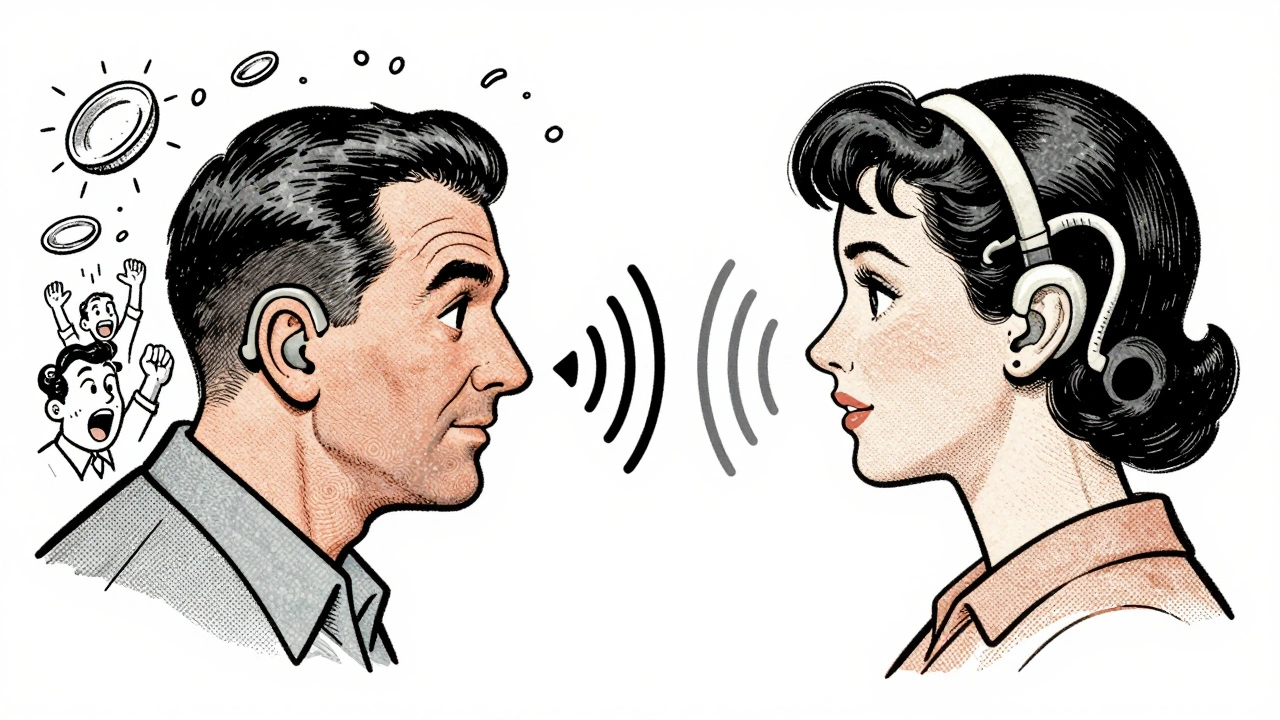
Which One Works Better?
Let’s cut through the noise. Neither CROS nor BAHD gives you true two-ear hearing. Both are workarounds. But they do different things well.Here’s what the data shows:
| Feature | CROS Hearing Aid | Bone-Anchored Device (BAHD) |
|---|---|---|
| How it works | Wirelessly transmits sound to good ear | Vibrates skull bone to deliver sound |
| Surgery required? | No | Yes |
| Cost (device + surgery) | $2,500-$4,000 | $7,000-$15,000 |
| Battery life | 2-3 days | 5-7 days |
| Sound quality in noise | Worsens in noisy environments | Improves clarity |
| Head shadow reduction | 8-10 dB | 8-10 dB |
| Sound localization | Minimal improvement | Modest improvement |
| Skin complications | None | Up to 63% (percutaneous) |
| Adaptation time | 1-2 weeks | 4-8 weeks |
| Best for | Normal hearing in good ear, low budget, no surgery | Mild-moderate hearing loss in good ear, active lifestyle, better sound quality |
Here’s the truth: if your good ear is perfectly healthy and you want to avoid surgery, CROS is a smart first step. It’s low-risk, low-cost, and easy to try. But if you’re in a noisy job - construction, teaching, hospitality - or you’re frustrated with CROS’s poor performance in restaurants, BAHD delivers real, measurable improvement. The CINGLE trial showed BAHD users had better speech understanding than CROS users when noise came from their deaf side. And while neither system restores full 3D hearing, BAHD comes closer.
One big surprise? Dropout rates. In a 2022 study, nearly half (46%) of CROS users stopped using their device after a year. Only 7% of BAHD users quit. Why? Because CROS promises more than it delivers. It makes you think you’re hearing normally. But in the real world - where noise is everywhere - it often makes things harder.
Who Should Choose What?
There’s no one-size-fits-all answer. But here’s a simple guide:- Choose CROS if: Your good ear has perfect hearing (pure-tone average ≤ 25 dB HL), you’re not in a noisy job, you hate the idea of surgery, and you want to test the waters. It’s a trial run.
- Choose BAHD if: Your good ear has mild hearing loss (up to 45-55 dB HL), you’re active (runner, cyclist, gym-goer), you’re tired of changing batteries every few days, and you want clearer, more natural sound - even if it means surgery.
- Consider a cochlear implant if: You’ve tried both and still struggle. New FDA guidelines (January 2024) now support cochlear implants for SSD after 6 months of failed CROS or BAHD use. CI gives the best sound localization - 18.3° error vs. 35° for CROS.
Also, watch for tinnitus. Nearly 78% of SSD patients have ringing in the ears. New CROS models like Signia CROS Pure 312 now include built-in tinnitus therapy. BAHDs don’t. If tinnitus is a problem, that could tip the scale.
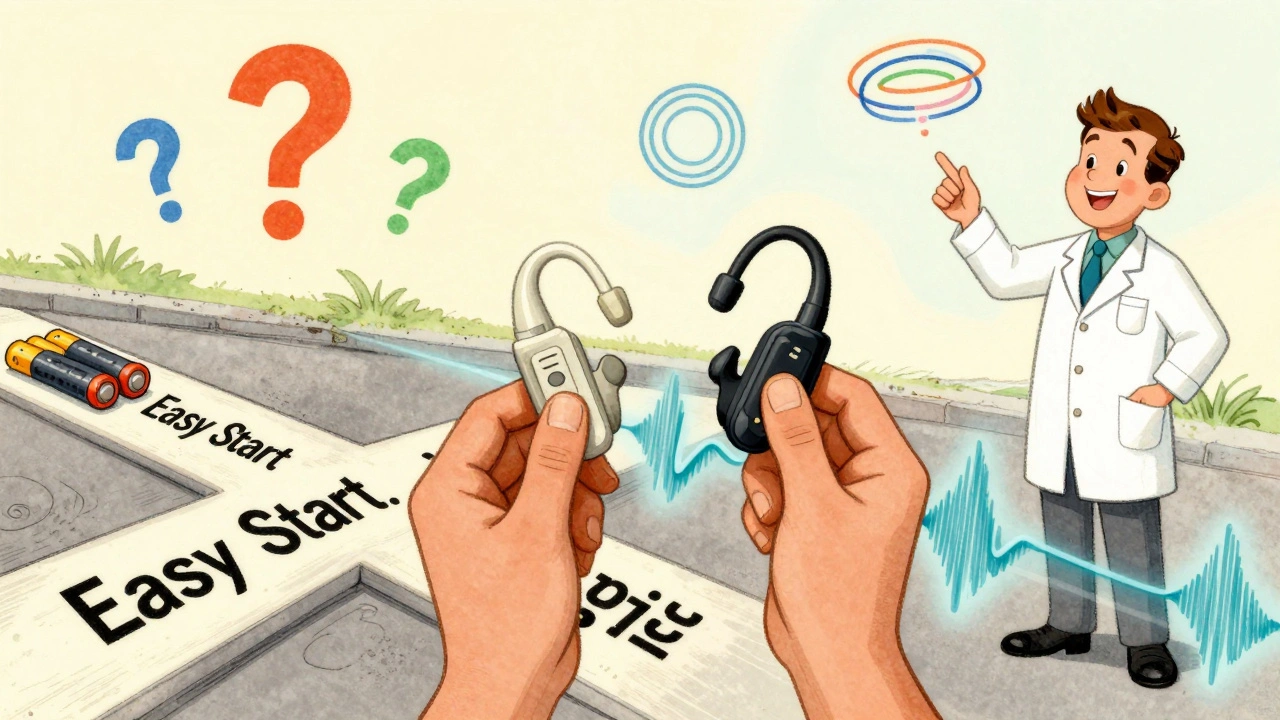
What’s Next for SSD Treatment?
The field is changing fast. Wireless CROS systems are getting smarter. Phonak and Oticon now use AI to filter background noise. Cochlear’s 2024 Baha 7 Smart Sound Processor uses machine learning to adapt to your environment. But the biggest shift is toward cochlear implants. Once considered a last resort, CI is now being recommended earlier. The CINGLE trial showed CI users had the best spatial hearing - by far. And surgical techniques are becoming less invasive.Meanwhile, CROS is still the most common first choice. Sixty-five percent of new SSD patients start with CROS, according to the American Academy of Audiology. But the tide is turning. BAHD adoption is growing at 8.7% per year. And as transcutaneous systems improve - with no skin holes, better batteries, and stronger signals - more people will skip CROS entirely.
One thing’s clear: you don’t have to live with single-sided deafness. You don’t have to guess at conversations or feel left out. There are real, proven solutions. The question isn’t whether to treat it. It’s which path fits your life.
Can CROS hearing aids restore normal hearing?
No. CROS systems don’t fix the deaf ear. They move sound from the deaf side to the good ear. You’re still hearing with one ear, just with better access to sounds from the other side. It helps with speech understanding and reduces the head shadow effect, but it doesn’t restore true binaural hearing or sound localization.
Is bone-anchored surgery risky?
The surgery is low-risk but not risk-free. The most common issue is skin irritation around the abutment - affecting 15-63% of users. Infections, minor bleeding, and delayed healing can happen. Transcutaneous systems reduce skin problems but may offer slightly less sound amplification. Serious complications like implant failure are rare (under 5%) when done by experienced surgeons.
How long do CROS and BAHD batteries last?
CROS systems use small size 13 or 312 batteries that last 2-3 days with normal use. BAHD processors use larger size 675 batteries that last 5-7 days. Battery life depends on usage - streaming audio or using noise reduction features drains them faster.
Can I try CROS before buying?
Yes. Most hearing centers offer a 2-week trial period for CROS systems. This lets you test it in real-life situations - at work, in traffic, at home - before committing. BAHDs can’t be trialed without surgery, so you’ll need to rely on consultations and patient reviews.
Will insurance cover CROS or BAHD?
CROS hearing aids are often covered under hearing aid benefits, but coverage varies. BAHDs are considered surgical devices and may be covered under medical insurance, not just hearing aid plans. Medicare rarely covers either. Medicaid coverage depends on your state. Always check with your provider and get pre-authorization.
Can I use a CROS with hearing loss in my good ear?
No. CROS systems are only designed for people with normal or near-normal hearing in the good ear (pure-tone average ≤ 25 dB HL). If your good ear also has hearing loss, a BAHD or cochlear implant is a better option. Some BAHD models can help even if your good ear has mild to moderate loss (up to 45-55 dB HL).
Do CROS systems help with tinnitus?
Some newer CROS models, like Signia CROS Pure 312, include built-in tinnitus therapy with sound masking. But CROS itself doesn’t cure tinnitus. It may help by providing more sound input, which can reduce the brain’s focus on ringing. BAHDs don’t have this feature.
What happens if I stop using my BAHD?
If you remove your BAHD processor, your hearing returns to its pre-device state - single-sided deafness. The implant stays in your skull, but without the processor, it does nothing. You won’t lose bone density or damage your ear. You can always reattach the processor later if you change your mind.





Wendy Chiridza
Been using a CROS for 3 years now and honestly it changed my life
I work in a call center and used to miss half the calls coming from my left side
Now I can hear everything without straining
Yeah the batteries die fast but I keep spares in my pocket
Worth every penny
Mark Gallagher
Ugh I can't believe people are still wasting money on CROS
It's a band-aid solution for lazy people who don't want to go under the knife
BAHD is the only real option if you actually care about your hearing
Anyone who says CROS works fine is just deluding themselves
My cousin tried it for 6 months then switched to Baha and now he's actually living again
Stop settling for less
And yes I know you're gonna say 'but it's cheaper' - well guess what your quality of life isn't a discount item
Pamela Mae Ibabao
Y'all are making this way too complicated
I had SSD after a bad ear infection and tried both
CROS felt like my brain was getting a constant text message from my dead ear
BAHD? Like someone turned on a switch inside my skull
My tinnitus dropped 70% too
And yes I had skin infections
But I use tea tree oil and it's fine now
Also the battery lasts longer than you think
And the sound quality? Night and day
Just sayin'
Gerald Nauschnegg
Hey I just got my BAHD last month and I'm obsessed
Went hiking yesterday and heard birds on my deaf side for the first time since I was 12
My dog barked from behind me and I actually turned to look
It's not just hearing anymore
It's feeling the world again
Also the magnet is so strong I can wear my headphones over it
And no I'm not sponsored lol
Just emotional
Palanivelu Sivanathan
Bro I'm from India and we don't even have access to these things
My cousin had SSD after a car crash
He tried everything
Then he just learned to read lips and smile through it
Why do we need technology to fix what we should just accept
Life is suffering
And maybe the real hearing aid is inner peace
Or maybe I'm just a monk now
Peace out
Joanne Rencher
So you're telling me I need to spend 15 grand to hear someone say 'pass the salt'?
My hearing's fine
I just ignore people on my left
It's called selective hearing
And it's free
Also I'm pretty sure this whole post is just a marketing brochure
Who even writes like this
And why do you care so much
Sara Larson
YAS QUEEN 😭👏
I'm so proud of you for even considering this
SSD is HARD and you're not broken
Whether you pick CROS or BAHD
You're already winning by seeking help
And if you're nervous about surgery
That's okay
Try CROS first
No shame
You deserve to hear your kids laugh
And your favorite song
And the wind in the trees
You got this 💪💖
Pooja Surnar
Who even uses CROS anymore
Its 2025
My aunt tried it and she said it sounded like a robot whispering in her ear
And she had to change batteries every day
BAHD is the only way
And if you cant afford it
Then you need to stop being lazy and get a second job
My cousin sold his car for his BAHD
And now he's happy
So stop making excuses
Sandridge Nelia
Thanks for the detailed breakdown
I'm considering CROS first since my good ear is still perfect
But I'm worried about the noise issue
Has anyone tried the newer AI models like Phonak CROS Marvel?
I read they have better noise filtering
Also - does anyone know if insurance covers the trial period?
My audiologist said yes but I want to hear from someone who actually did it
And if you're on BAHD - how long did it take to feel 'normal'?
Thanks in advance
Erik van Hees
Wrong
You're all missing the real point
Neither CROS nor BAHD are the answer
It's cochlear implants
Period
The CINGLE trial showed CI users had 18.3° spatial error vs 35° for CROS
That's not even close
And the FDA updated guidelines in Jan 2024 to allow CI after 6 months of failed CROS/BAHD
So why are you wasting time with these half-measures
Go straight to the source
And yes I'm an audiologist
I've seen this a hundred times
People waste years on CROS
Then end up with CI anyway
Just skip the middleman
Cristy Magdalena
I just want to say
I'm so tired of everyone pretending this is a simple choice
I had BAHD surgery
And yes the sound is amazing
But the infections
The constant cleaning
The fear it'll fall off
The way strangers stare at the magnet
And the guilt when I forget to charge it
And the loneliness
Because no one else understands
I just want to be heard
Not just by my ear
But by people
Can we talk about that?