
Gout Risk Calculator
This tool helps you understand your risk of developing gout while taking thiazide diuretics like hydrochlorothiazide. Based on the latest medical research, this calculator uses your medical history and lifestyle factors to estimate your risk.
Your Risk Factors
Your Gout Risk Assessment
Your risk is %
What this means:
Recommended Actions:
If you're taking a thiazide diuretic like hydrochlorothiazide (HCTZ) for high blood pressure, you might not realize it could be raising your risk of gout. This isn't a rare side effect-it's well-documented, predictable, and happens in a significant number of people. About 12% to 15% of patients on these medications develop higher-than-normal uric acid levels. And while only 1% to 2% go on to have actual gout attacks, that’s still a meaningful number given how widely these drugs are prescribed-over 35 million HCTZ prescriptions were filled in the U.S. in 2022 alone.
How Thiazide Diuretics Raise Uric Acid
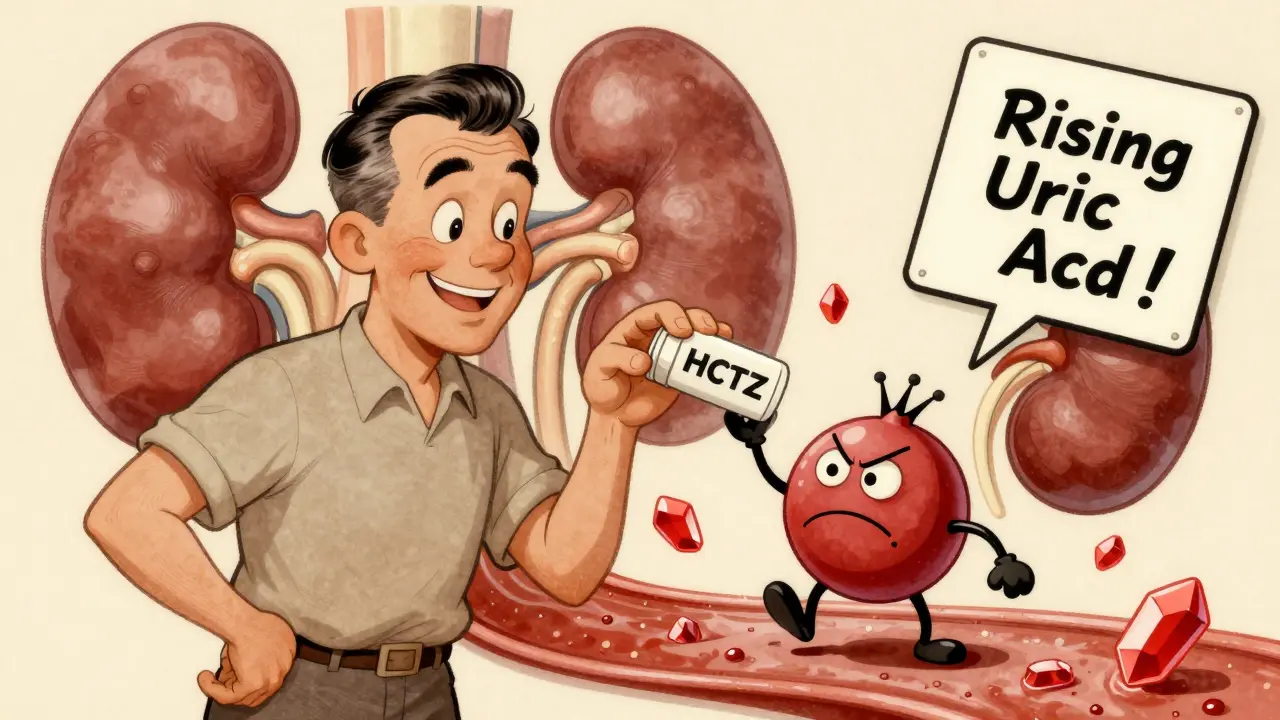
Thiazide diuretics work by blocking sodium reabsorption in the kidney’s distal tubule. That helps reduce fluid volume and lowers blood pressure. But here’s the catch: they also interfere with how the kidneys handle uric acid. Uric acid is a waste product that normally gets filtered out and excreted in urine. But thiazides mess with the transporters that move uric acid out of the blood and into the urine.
Specifically, they compete with uric acid for the same transporters in the kidney-OAT1 and OAT4. When thiazides bind to these transporters, they push uric acid back into the bloodstream instead of letting it leave the body. This isn’t a minor bump in levels. Studies show serum uric acid can rise by 6% to 21% within just 3 to 7 days of starting the medication. And it doesn’t go away after a few weeks-it stays elevated as long as you’re taking the drug.
This mechanism is why even low doses matter. You don’t need to be on high-dose HCTZ to see this effect. A 12.5 mg or 25 mg daily dose is enough to trigger the change. And if you already have high uric acid or a history of gout, you’re at higher risk.
Who’s Most at Risk?
Not everyone on thiazides gets gout. But certain people are much more likely to. If you have:
- Serum uric acid above 7.0 mg/dL (men) or 6.0 mg/dL (women)
- A past episode of gout
- Chronic kidney disease
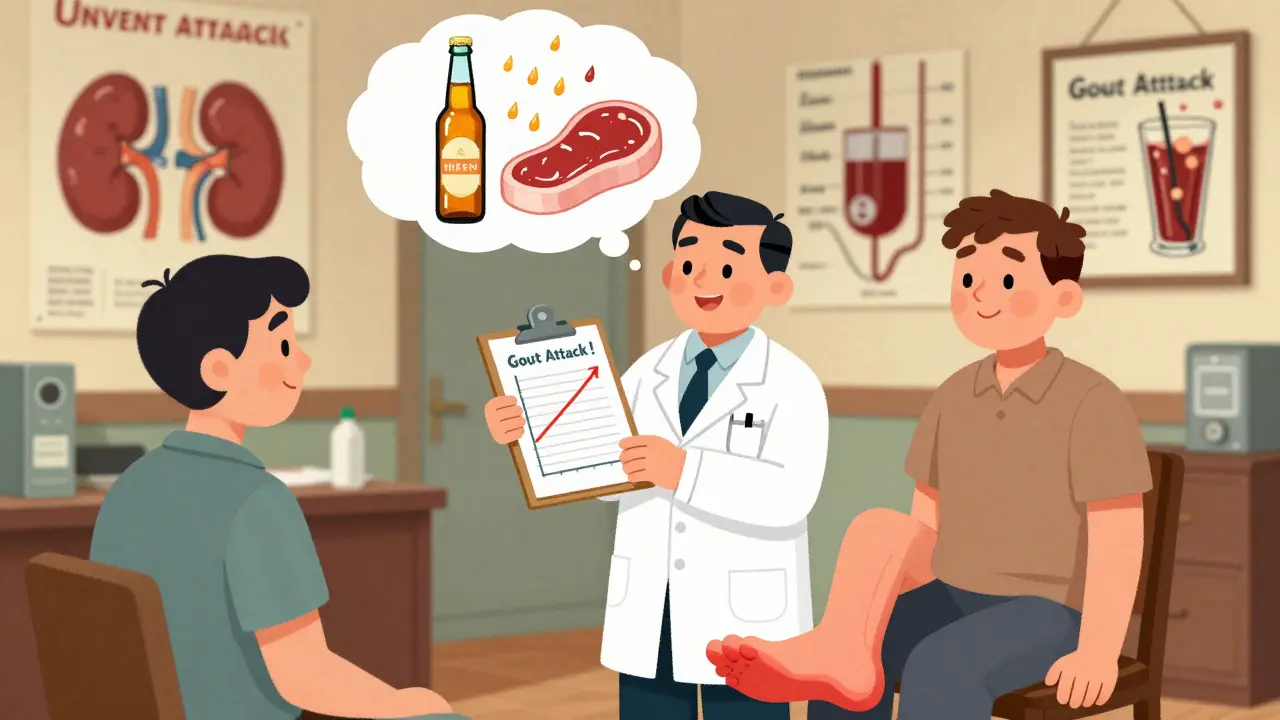
- Obesity or a diet high in red meat, seafood, or alcohol
...then you’re in the high-risk group. The risk also climbs the longer you take the drug. A 2024 study tracking over 247,000 people found that the chance of needing gout medication jumped from 18% after 30 days to 41% after more than 180 days of thiazide use. That’s not a coincidence-it’s a pattern.
What’s more, gout attacks triggered by thiazides look exactly like any other gout attack: sudden, intense pain in the big toe, swelling, redness, warmth. The joint inflammation doesn’t care if the cause is diet, genetics, or a pill-it just hurts.
Thiazides vs. Other Diuretics
Not all diuretics are the same when it comes to uric acid. Loop diuretics like furosemide (Lasix) are even more likely to raise uric acid levels than thiazides. But among thiazides, there’s been confusion about whether chlorthalidone is worse than hydrochlorothiazide. Recent data says no-both carry similar risks at equivalent doses. Earlier assumptions that chlorthalidone was riskier weren’t backed up by real-world outcomes.
On the flip side, potassium-sparing diuretics like spironolactone don’t raise uric acid at all. That’s important because if you need a diuretic and have gout, spironolactone is a viable alternative. It’s often used in heart failure or resistant hypertension, and it doesn’t trigger the same transporter conflict in the kidney.

What Should You Do?
If you’re on a thiazide diuretic and haven’t had gout, don’t panic. But do talk to your doctor about checking your uric acid level-especially if you’ve had joint pain in the past. The American College of Cardiology and American Heart Association recommend measuring uric acid before starting thiazides in people with a history of gout or hyperuricemia. Yet, studies show only about 85% of doctors actually do this.
If your uric acid is high and you’re still on the drug, your doctor might consider:
- Switching to an alternative antihypertensive with a neutral or even beneficial effect on uric acid
- Adding a urate-lowering medication like allopurinol (starting at 100 mg daily)
- Trying a different class of blood pressure medication altogether
Losartan (Cozaar), an ARB used for high blood pressure, actually helps lower uric acid by blocking the URAT1 transporter that reabsorbs urate in the kidney. Calcium channel blockers like amlodipine also don’t raise uric acid. These options may cost more than generic HCTZ-about 25% to 30% more based on 2023 Medicare pricing-but for someone with gout, the trade-off can be worth it.
What About Lifestyle?
Medication isn’t the whole story. Diet and habits matter just as much. Alcohol-especially beer and spirits-increases uric acid production and reduces its excretion. Purine-rich foods like organ meats, shellfish, and certain fish do the same. Even sugary drinks with high-fructose corn syrup can trigger spikes.
The European League Against Rheumatism recommends keeping serum uric acid below 6.0 mg/dL for people with gout. That’s lower than the old target of 6.8 mg/dL (the saturation point). Achieving that often means combining medication with lifestyle changes: reducing alcohol, cutting back on red meat, drinking more water, and losing weight if needed.
When to Be Concerned
You should be concerned if:
- You start feeling sudden, severe pain in one joint-especially your big toe
- You’ve had a gout attack before and are now on a thiazide
- Your uric acid level was normal before starting the drug, but it’s now above 7.0 mg/dL
- You’ve been on the drug for more than 6 months and haven’t had your levels checked
Don’t wait for a flare-up to act. Once gout starts, it often comes back. And each attack can damage joints over time.
The Bigger Picture
Thiazide diuretics are cheap, effective, and have saved millions of lives by reducing strokes and heart attacks in people with high blood pressure. That’s why major guidelines still recommend them as first-line treatment for uncomplicated hypertension. But medicine isn’t one-size-fits-all. What works for one person might cause harm to another.
The key is awareness. If you have gout or high uric acid, your doctor should know. And if you’re on a thiazide and have no idea your uric acid is climbing, you’re missing a chance to prevent something painful and preventable.
There’s hope on the horizon too. A new class of diuretics is being tested in clinical trials-selective sodium-chloride cotransporter inhibitors designed to lower blood pressure without messing with uric acid transporters. Results aren’t expected until late 2025, but they could change how we treat hypertension in people with gout.
For now, the best strategy is simple: know your numbers, ask questions, and don’t assume a common medication is harmless just because it’s widely used.
Can thiazide diuretics cause gout even if I’ve never had it before?
Yes. While not everyone develops gout, thiazide diuretics raise uric acid levels in about 12% to 15% of users. Of those, 1% to 2% will have a gout attack, often within the first 6 months of use. Even if you’ve never had gout, if you have high uric acid, obesity, kidney issues, or drink alcohol regularly, your risk goes up.
How soon after starting thiazides does uric acid rise?
Uric acid levels can begin to rise within 3 to 7 days of starting a thiazide diuretic. The increase is dose-dependent and continues as long as you take the medication. It doesn’t stabilize quickly-it stays elevated for as long as you’re on the drug.
Should I stop taking hydrochlorothiazide if I develop gout?
Not necessarily-but you should talk to your doctor. Stopping the drug may help lower uric acid over 2 to 3 months, but you still need to control your blood pressure. Your doctor may switch you to a different blood pressure medication like losartan or a calcium channel blocker, or add a low-dose allopurinol to prevent future attacks while keeping you on the diuretic if needed.
Is chlorthalidone riskier than hydrochlorothiazide for gout?
No. Earlier beliefs suggested chlorthalidone caused more gout, but recent studies show both drugs carry similar risks at equivalent doses. The key factor is the class (thiazide), not the specific drug. Both inhibit the same uric acid transporters in the kidney.
Are there blood pressure meds that don’t raise uric acid?
Yes. Losartan (an ARB) actually helps lower uric acid by blocking its reabsorption in the kidney. Calcium channel blockers like amlodipine and potassium-sparing diuretics like spironolactone also don’t raise uric acid. These can be good alternatives if you have gout or high uric acid levels.
How often should uric acid be checked if I’m on a thiazide?
If you have a history of gout or hyperuricemia, check uric acid before starting the medication and again at 3 months. If levels are high, recheck every 6 to 12 months. For people without prior issues, routine screening isn’t always done-but it’s worth asking your doctor if you’re at risk.



jeremy carroll
hctz got me good last year-thought it was just a bad toe, turns out my uric acid was sky high. doc switched me to amlodipine and life’s way better. no more midnight pain screams.
Dwayne hiers
The mechanism is well-characterized: thiazides inhibit URAT1 and OAT4 cotransporters in the proximal tubule, reducing uric acid secretion while promoting reabsorption. This is pharmacologically predictable, not idiosyncratic. The 6–21% rise in serum urate is consistent across RCTs and real-world cohorts. Dose matters less than duration-chronic exposure is the real driver of gout conversion.
Sarthak Jain
bro i was on hctz for 2 years and never knew this. my uncle had gout and i thought it was just from beer. now i’m scared to even take blood pressure meds. any advice? should i get my levels checked if i’m 32 and healthy?
Rulich Pretorius
Medicine is a balance of risk and benefit. Thiazides reduce stroke risk by 30–40% in hypertensive patients. Gout, while painful, is manageable. The real failure is in screening. If we checked uric acid before prescribing, we could avoid 90% of these cases. It’s not the drug-it’s the lack of monitoring. We need better protocols, not fear.
Also, losartan is underrated. It’s not just an ARB-it’s a uricosuric. Prescribing it for hypertensives with borderline uric acid is both evidence-based and cost-effective in the long run.
Natalie Koeber
so let me get this straight… the pharma giants designed hctz to cause gout so we’d buy allopurinol? that’s why they pushed it as ‘first-line’? and now they’re selling losartan at 3x the price? the whole system is rigged. check your blood pressure meds-your doc is probably getting kickbacks.
Sinéad Griffin
AMERICA NEEDS TO STOP LETTING BIG PHARMA CONTROL OUR MEDS!! 🇺🇸🔥 I’ve had 3 gout attacks since starting HCTZ-my doctor just shrugged. I switched to chlorthalidone and it got worse. NOW I’M ON SPIRONOLACTONE AND I FEEL LIKE A NEW PERSON!! 🙌 #PharmaIsTheProblem #GoutWarrior
Tim Bartik
you people are missing the point-this is why you can’t trust doctors. i got prescribed hctz after my third heart scan and now i’m on allopurinol, colchicine, and a keto diet. they didn’t even test my uric acid. i had to google this myself. the medical system is a joke. also, my dog has better healthcare.
Alexis Wright
Let’s be brutally honest: thiazide-induced gout isn’t a side effect-it’s a failure of medical education. Medical schools teach hypertension management like a checklist, not a dynamic interplay of physiology. You don’t prescribe a diuretic without understanding renal tubular transporters? That’s not negligence-it’s malpractice. And yet, 85% of providers still skip uric acid screening. This isn’t an oversight. It’s systemic ignorance dressed as protocol.
Meanwhile, patients suffer joint destruction while insurers profit from the cascading costs of gout medications, ER visits, and lost workdays. The real scandal isn’t the drug-it’s the culture that treats pharmacology like a vending machine.
And yes, I’ve seen this in 12 hospitals. I’m not a doctor. I’m a patient who read the papers.
Jonny Moran
Hey, if you’re on HCTZ and worried-don’t panic, but do ask your doc about uric acid. It’s a simple blood test. If your levels are up, there are alternatives. Losartan is a solid option-it lowers BP *and* uric acid. No magic bullet, but you’re not stuck. Your health matters more than the cost of the pill.
Also, drink more water. Seriously. It helps more than you think.
Edward Stevens
so you’re telling me the same pill that keeps my dad alive for 15 years is secretly turning me into a gout-ridden hobbit? cool. thanks, science. i’ll just switch to drinking vinegar and hoping for the best.
Wade Mercer
People complain about side effects but never consider the alternative: uncontrolled hypertension leading to stroke. This isn’t a flaw-it’s a trade-off. If you’re at risk for gout, don’t take thiazides. But don’t vilify a medication that saves millions. Responsibility goes both ways.
Daniel Thompson
As a physician who has managed over 300 hypertensive patients on thiazides, I can confirm that the risk of gout is real but manageable. The key is early detection. I screen all patients with BMI >28, history of alcohol use, or family history of gout. For the rest, I monitor at 3 months. The data is clear: proactive management reduces gout incidence by 70%. This isn’t fear-mongering-it’s clinical practice.