

When you feel bloated after eating beans, dairy, or even just a big meal, you’re not alone. Millions reach for an OTC remedy-maybe a pill, a drop, or a chewable tablet. But not all gas relief products work the same way. Two main types dominate the shelf: simethicone and enzyme-based products like Beano and Lactaid. Knowing the difference isn’t just helpful-it can save you money, time, and discomfort.
How Simethicone Works (And When It’s Most Useful)
Simethicone doesn’t stop gas from forming. Instead, it helps your body get rid of it faster. Think of it like popping bubbles in a soda. Gas in your gut forms tiny bubbles that get trapped, causing pressure and bloating. Simethicone is a silicone-based compound that breaks the surface tension of those bubbles, making them stick together into bigger ones. Bigger bubbles are easier to pass-through belching or flatulence.
It’s not absorbed into your bloodstream. That’s why it’s safe for babies, pregnant women, and people on multiple medications. You can take it after meals, before bed, or right when you start feeling bloated. Most people feel relief within 15 to 30 minutes. Brands like Gas-X, Mylicon, and Phazyme all contain simethicone in doses ranging from 40mg to 125mg per unit. The maximum daily dose is 500mg-easy to stay under if you follow the label.
Studies show simethicone helps about 73% of people with occasional gas. On Amazon, Gas-X has over 18,000 reviews with a 4.5-star rating. People say things like, “Works instantly on plane rides,” or “I keep it in my purse for after dinner.” But here’s the catch: if you’re already swollen and tight, simethicone might not do much. It doesn’t reduce the amount of gas-you’re just making the existing gas easier to move.
Enzyme Products: Stopping Gas Before It Starts
Enzymes work differently. They don’t manage gas-they prevent it. Two common enzymes are lactase and alpha-galactosidase.
Lactase breaks down lactose, the sugar in milk and dairy. If you’re lactose intolerant, your body doesn’t make enough of it. Undigested lactose ferments in your colon and creates gas. Lactaid, Dairy Digest, and generic lactase supplements give you the enzyme your body is missing. Take one just before eating dairy, and you can enjoy cheese, ice cream, or yogurt without the aftermath. Clinical studies show 85% of lactose-intolerant users get relief when they take it correctly.
Alpha-galactosidase is the enzyme in Beano. It breaks down complex carbs found in beans, broccoli, cabbage, and whole grains-foods your body can’t digest on its own. These carbs reach your gut bacteria, which then ferment them into gas. Beano gives you the enzyme to break them down before they get there. Take it 5-10 minutes before your meal. If you forget? Too late. It won’t help once the gas is already forming.
But here’s the reality: Beano doesn’t work for everyone. Some people see 70% fewer symptoms. Others barely notice a difference. Why? Because gut bacteria vary from person to person. One study found effectiveness ranged from 45% to 78% depending on the food and individual microbiome. It’s not a guarantee-it’s a tool.
Simethicone vs Enzymes: Which One Do You Need?
Here’s the simple breakdown:
- Use simethicone when you feel bloated, full, or pressured-right now. It’s your emergency button. Great for unpredictable meals, restaurant dining, or travel.
- Use enzymes when you know what’s coming. Planning to eat chili with beans? Take Beano before. Want to have ice cream? Take Lactaid first.
Simethicone wins for speed and simplicity. Enzymes win for prevention-if you know your trigger foods and remember to take them on time.
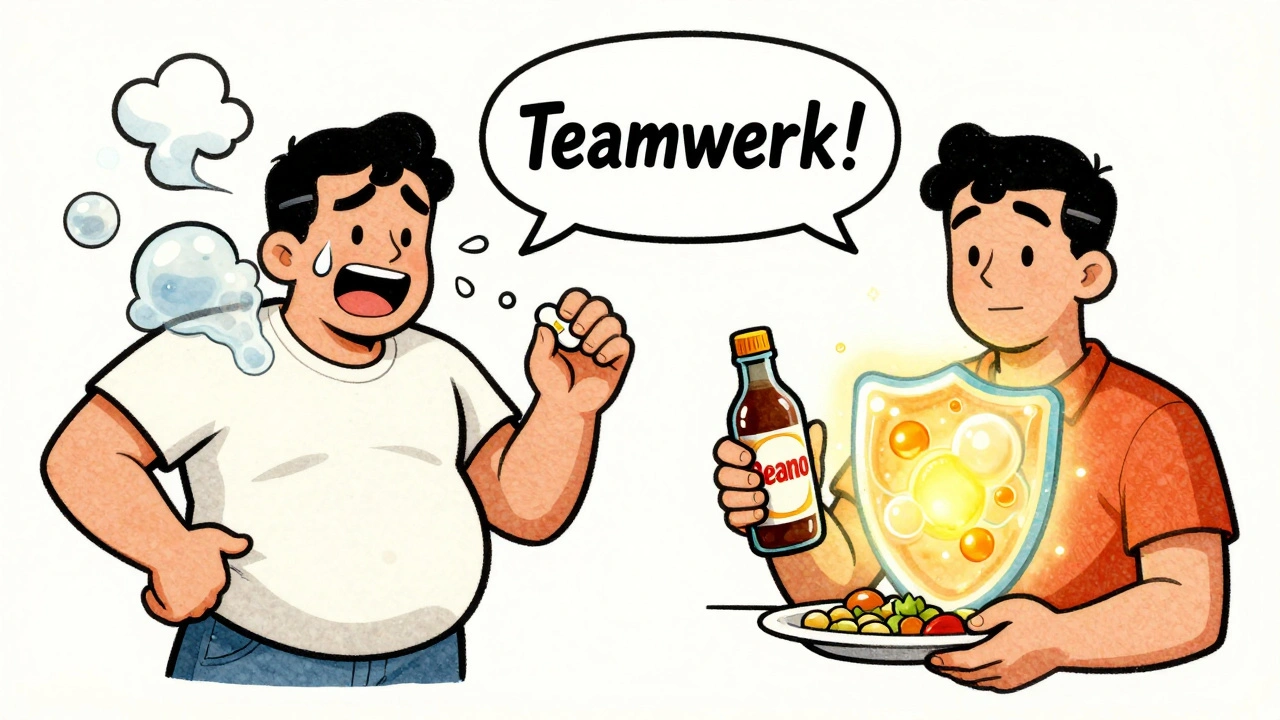
Many people use both. One Reddit user wrote: “Simethicone is my emergency button for gas pain, but I use Beano preventatively when I know I’ll be eating problematic foods-they work best as a team.” That’s the smartest approach.

What the Experts Say
Doctors agree: simethicone is the go-to for immediate relief. The National Institute of Diabetes and Digestive and Kidney Diseases (NIDDK) gives it a “Recommended” rating with strong evidence. Mayo Clinic gastroenterologists call it the “gold standard” for symptom control.
Enzymes get more cautious reviews. Lactase? Strongly recommended for confirmed lactose intolerance. Beano? Only conditionally recommended. Why? Because its results are inconsistent. If you’ve tried Beano and it didn’t work, you’re not alone. It’s not broken-you just might be one of the 30-55% of people it doesn’t help much.
Some experts warn against over-relying on these products. Dr. Robynne Chutkan, author of The Great Gas Fix, points out that OTC remedies treat symptoms, not causes. If you’re constantly bloated, maybe it’s not about gas-it could be small intestinal bacterial overgrowth (SIBO), food sensitivities, or slow motility. Those need different solutions.
Real-World Costs and Practical Tips
Price matters. A 200-count bottle of Gas-X (125mg simethicone) costs about $12.50 at CVS. A 100-count bottle of Beano runs $19. Lactaid is in the middle-around $16 for 90 tablets. If you use it daily, that adds up.
Here’s how to use them right:
- For simethicone: Chew or swallow after meals or when bloating hits. No need to time it. Max 4 doses a day, 500mg total.
- For lactase: Take within 5 minutes of eating dairy. One tablet handles about 18 oz of milk.
- For Beano: Take 5-10 minutes before eating beans, broccoli, or lentils. One drop covers a serving.
Don’t expect enzymes to fix gas from carbonated drinks, swallowing air, or stress. Those need different fixes-like eating slower or avoiding straws.
What’s New in Gas Relief?
The market is changing. Combination products-like Gas-Zyme, which has both simethicone and alpha-galactosidase-are growing fast. Sales jumped nearly 19% last year. More people are realizing they need both prevention and relief.
Some companies are testing longer-lasting simethicone. A new formulation in clinical trials could provide relief for up to 8 hours instead of 2-3. That could be a game-changer for people with chronic bloating.
Personalized medicine is coming too. Viome, a gut health testing company, now analyzes your microbiome and recommends specific enzyme products based on your unique digestion profile. It’s expensive-$200 for a test-but it’s a glimpse into the future.
When to See a Doctor
OTC remedies are great for occasional gas. But if you’re bloated every day, have pain, diarrhea, constipation, or weight loss, it’s time to talk to a doctor. These could be signs of IBS, SIBO, celiac disease, or other conditions that need more than a pill.
Also, if you’re using these products daily for more than two weeks without improvement, you’re masking a deeper issue. Symptom relief isn’t a cure.
Most people find that combining smart eating habits with the right OTC tool works best. Avoid trigger foods. Eat slowly. Drink water. Move after meals. Use simethicone when you need it. Use enzymes when you know what’s coming. And don’t feel guilty for using them-they’re safe, effective, and widely used.
Is simethicone safe to take every day?
Yes. Simethicone isn’t absorbed by the body, so it doesn’t build up or cause side effects. You can take it up to four times a day, with a maximum of 500mg daily. Many people use it daily without issues. But if you’re relying on it every day for bloating, it’s worth checking with a doctor to see if there’s an underlying cause.
Can I take Beano and simethicone together?
Absolutely. Many people do. Take Beano 5-10 minutes before your meal to prevent gas formation, then take simethicone afterward if you still feel bloated. They work on different parts of the problem and don’t interfere with each other.
Why doesn’t Beano work for me?
Beano only breaks down certain complex carbs-like those in beans and cruciferous vegetables. If your bloating comes from dairy, carbonation, swallowing air, or stress, Beano won’t help. Also, your gut bacteria may not respond well to alpha-galactosidase. Try taking it 10 minutes before eating, not 5. And make sure you’re using enough drops per serving.
Is Lactaid better than dairy-free milk?
It depends. Lactaid lets you enjoy real dairy without symptoms-if you’re lactose intolerant. Dairy-free milk (almond, oat, soy) removes lactose entirely, so you don’t need the enzyme. If you prefer the taste of real milk and just want to avoid gas, Lactaid is fine. If you also want to cut out dairy for other reasons (lactose sensitivity, ethics, etc.), dairy-free is the better long-term choice.
Do simethicone products expire?
Yes, but they’re stable. Most have a shelf life of 2-3 years. Even after expiration, simethicone usually remains safe to use-it just might not work as well. If the tablets look cracked, discolored, or smell odd, throw them out. Liquid drops should be discarded if cloudy or separated.
Are there natural alternatives to OTC gas remedies?
Some people find relief with peppermint tea, ginger, or activated charcoal. Peppermint relaxes gut muscles, which can help gas move. Ginger reduces inflammation. Activated charcoal may bind gas, but studies show mixed results. None are as reliable or fast as simethicone or enzymes. They’re worth trying for mild cases, but don’t replace proven treatments if you’re in real discomfort.
Final Thoughts
You don’t need to suffer through bloating. Whether it’s a holiday meal, a late-night snack, or a daily habit, there’s a solution. Simethicone gives you quick relief. Enzymes give you control. Use them wisely. Know your triggers. And if you’re still struggling after trying both, it’s not you-it’s your gut. Time to talk to a professional.

aditya dixit
It's funny how we treat gas like it's some enemy to defeat, when it's just our bodies doing their job. Simethicone doesn't fix the root-it just lets the bubbles coalesce and escape. Kinda like letting steam out of a pressure cooker instead of turning down the heat.
Enzymes? They're like giving your gut a new set of tools. But here's the thing-we're all different machines. What works for your neighbor might do squat for you. Maybe the real solution isn't in the pill bottle, but in listening to what your body's been whispering all along.
Lynette Myles
They’re hiding the truth-simethicone is just a placebo with silicone. The real cause? Glyphosate in your beans and dairy. Big Pharma doesn’t want you to know their products are just masking the damage from Roundup.
Michael Dioso
Wow, so you’re telling me people actually believe this? Beano? Please. If you’re eating beans and getting bloated, you’re not ‘lactose intolerant’-you’re just a weak digestive system. Stop taking pills and start eating real food. No one in 1950 needed Beano. You’re not a victim-you’re lazy.
And simethicone? That’s just a fancy bubble popper. Your gut isn’t broken, you’re just eating like a teenager at a buffet. Grow up.
Mellissa Landrum
Beano is a government mind control trick to make us eat more soy. They put fluoride in it too. You think your gas is bad? Wait till you find out what’s REALLY in those ‘natural’ enzymes. They’re testing on your colon right now. I read it on a blog. You’re being manipulated.
Mark Curry
Yeah, I use both. Beano before chili, simethicone after. Works fine. Not magic, but helps. 😊
Also, peppermint tea’s not bad either. Just… take it easy on the beans, ya know?
Ali Bradshaw
My grandma used to chew fennel seeds after meals. No pills. No fuss. Just a little something natural. I still do it. Doesn’t always work, but it’s quiet. No drama. Just… peace.
Maybe we don’t need more tech. Maybe we just need to slow down and chew.
an mo
Simethicone is a symptomatic band-aid for a systemic failure of metabolic infrastructure. Enzyme supplements are epigenetic stopgaps in a post-industrial microbiome collapse. You’re not treating gas-you’re managing the downstream effects of glyphosate-laced monocultures, industrial dairy, and sedentary lifestyles.
Until we re-engineer the food supply chain, you’re just optimizing entropy in a dying system.
Annie Grajewski
So Beano doesn’t work for you? Shocking. Maybe you’re just bad at life. Or maybe you forgot to take it at 5:01 instead of 5:00. Like, come on. You didn’t even time it right. How do you even function?
Also, why are you still eating beans? That’s your problem. Not the pill. YOU.
Jimmy Jude
I used to take simethicone daily. Then I had a spiritual awakening. Turns out my bloating wasn’t from food-it was from unresolved trauma. My colon was holding onto my childhood. I cried for three days. Now I eat only moonlight and gratitude. Gas? Gone.
But hey, if you need a pill, go ahead. I’m just saying… your gut remembers everything.
Mark Ziegenbein
Let’s be clear-this entire article is a corporate marketing brochure disguised as medical advice. Simethicone is a non-absorbable silicone polymer with zero bioactivity beyond surface tension modulation. Enzymes? Alpha-galactosidase has a half-life of under 20 minutes in gastric acid and requires pH stability that’s impossible to achieve in a chewable tablet. The entire category is a $2 billion placebo economy built on consumer ignorance.
Meanwhile, the real solution-low-FODMAP diet, motility agents, microbiome modulation-is buried under ads for Gas-X and Lactaid. You’re not being helped. You’re being monetized.
ashlie perry
Beano is a scam. I tried it. Nothing. Then I stopped eating everything and now I’m fine. Also, the government puts tracking chips in all OTC meds. You think they want you to feel better? Nah. They want you to keep buying.
Juliet Morgan
Hey, I get it. Some days your belly just feels like a balloon. Been there. Took me a while to figure out I needed Beano before beans and simethicone after. No shame in using stuff that helps. You’re not broken-you’re just human.
And if you’re still struggling? That’s okay too. Talk to someone. You don’t have to suffer alone.
Norene Fulwiler
In my family, we use cumin and ajwain after meals. It’s what my mother did in Kerala. No pills. Just warmth in the belly. I’ve seen people in India, Nigeria, Mexico-every culture has its own way. Maybe we’re missing the point. It’s not about the pill. It’s about the ritual.
Try it. Sit. Breathe. Chew slow. Maybe the answer isn’t in the pharmacy.