
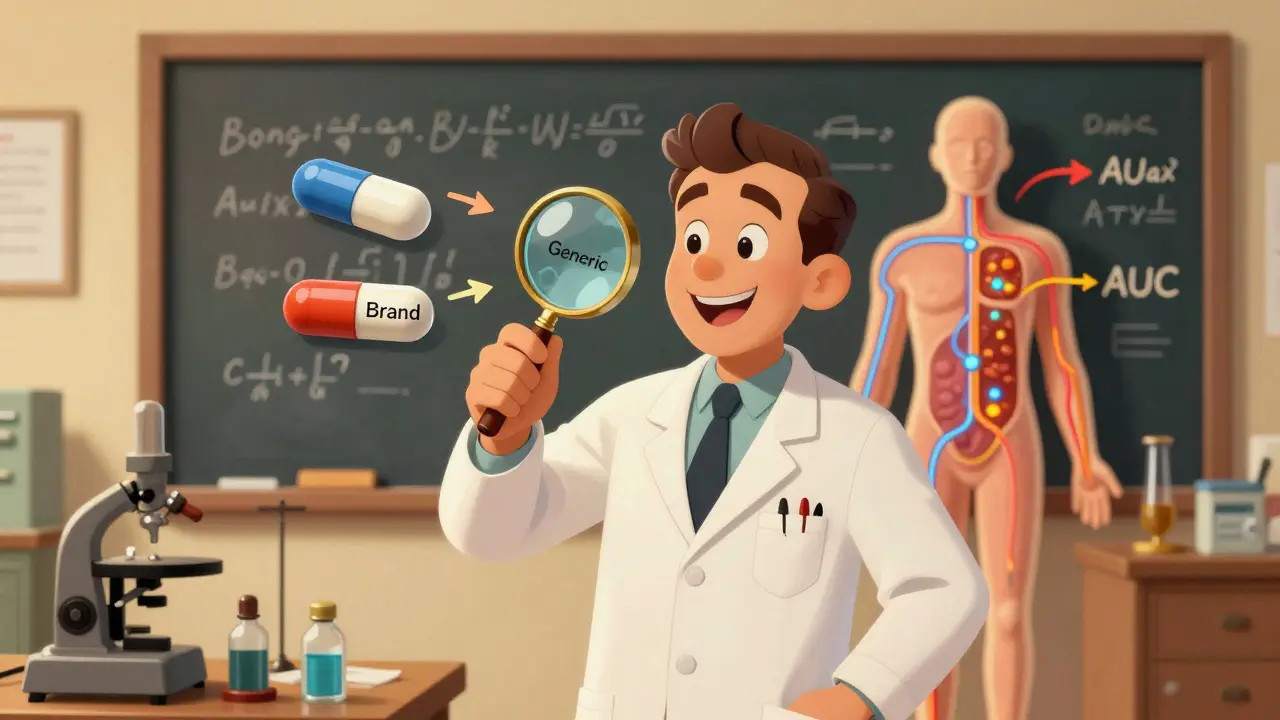
When you pick up a generic version of your prescription, you expect it to work just like the brand-name drug. But how do regulators know it actually does? The answer lies in pharmacokinetic studies - the most common and trusted method used worldwide to prove that a generic drug behaves the same way in your body as the original. Yet, calling it the "gold standard" isn’t quite right. It’s more accurate to say it’s the most practical, scientifically validated tool we have - and even that comes with limits.
How Pharmacokinetic Studies Work
These studies track how your body handles a drug after you take it. Specifically, they measure two key things: how fast the drug gets into your bloodstream (Cmax), and how much of it gets absorbed over time (AUC, or area under the curve). These numbers tell scientists whether the generic version releases the same amount of active ingredient at the same speed as the brand-name drug.
The FDA requires that the 90% confidence interval for both Cmax and AUC falls between 80% and 125% when comparing the generic to the brand. That means if the brand drug gives you an AUC of 100 units, the generic must deliver between 80 and 125 units. If it’s outside that range, the drugs aren’t considered equivalent - and the generic won’t be approved.
These tests are done in healthy volunteers - usually 24 to 36 people - in a crossover design. That means each person takes both the generic and the brand-name drug at different times, with a washout period in between. This setup cuts down on individual variation and gives cleaner results. Studies are often done both fasting and after eating, especially for drugs that absorb differently with food, like certain antibiotics or cholesterol medications.
Why It’s Not Really a "Gold Standard"
The FDA itself says bioequivalence isn’t a gold standard - it’s a surrogate. That’s a big distinction. A gold standard would mean we’re directly measuring whether the drug works the same in patients - like comparing how well two heart medications lower blood pressure or prevent strokes. But that’s expensive, slow, and often unethical. You can’t give one group a placebo when you already know the drug works.
So instead, regulators use pharmacokinetics as a proxy. If the drug enters the bloodstream the same way, it’s assumed it will have the same effect. For most pills - especially simple, immediate-release ones - this works extremely well. Post-marketing data from the FDA shows failure rates below 2% for these drugs. That’s why over 95% of generic approvals in 2022 relied on pharmacokinetic studies.
But here’s the catch: what works for a simple tablet doesn’t always work for complex formulations. Take topical creams, inhalers, or injectables. For these, the drug doesn’t just need to enter the bloodstream - it needs to reach the right tissue in the right amount. A cream might look identical on the label, but if the inactive ingredients change how it penetrates the skin, the effect can be different. In those cases, measuring blood levels tells you almost nothing.
Where Pharmacokinetic Studies Fall Short
There are real-world examples where two generics passed all pharmacokinetic tests - same Cmax, same AUC, same dissolution profile - but still behaved differently in patients. One infamous case involved generic versions of gentamicin, an antibiotic. Even though all versions matched the innovator drug in lab tests, some patients had unexpected side effects or treatment failures. The problem? The generics had different impurity profiles that didn’t show up in standard pharmacokinetic metrics.
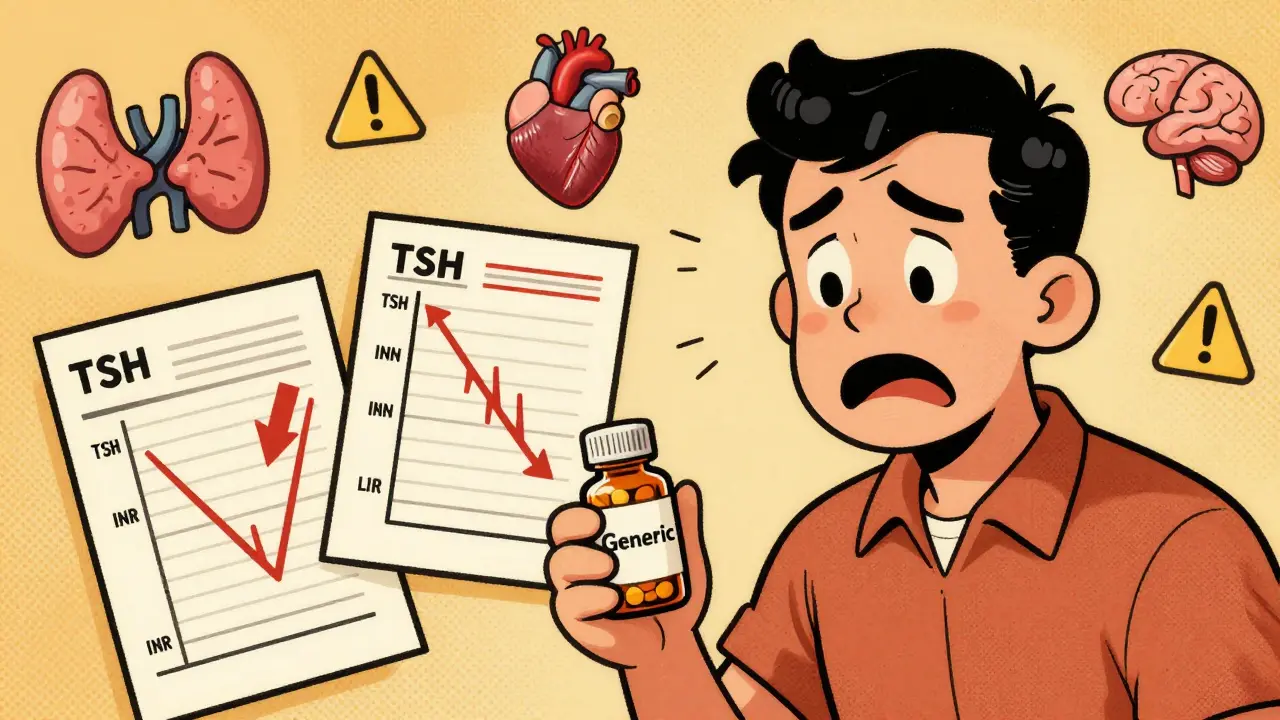
Narrow therapeutic index (NTI) drugs are another big concern. These are medications where a tiny difference in blood level can mean the difference between effectiveness and toxicity. Think warfarin, phenytoin, or lithium. For these, the FDA now requires tighter limits - often 90% to 111% - for Cmax and AUC. Even then, some clinicians still prefer sticking with the brand name because they’ve seen cases where switching generics caused issues, even within the "acceptable" range.
And then there’s the problem of excipients - the fillers, binders, and coatings that make the pill hold together. Two drugs can have identical active ingredients, but if one uses a different coating that dissolves slower, it can delay absorption. Pharmacokinetic studies might catch this - but only if they’re designed well. Many generic manufacturers struggle with this, especially with extended-release formulations. A change as small as switching from lactose to mannitol can alter how the drug releases over 12 hours.

What Happens When Pharmacokinetics Isn’t Enough?
For complex products, regulators are turning to other tools. For topical drugs, dermatopharmacokinetic (DMD) methods are becoming more common. These measure drug levels directly in the skin using tiny patches - not blood. Studies show DMD can detect differences between formulations with over 90% accuracy, something traditional blood tests can’t do.
For inhaled drugs, lung deposition studies using imaging techniques are replacing some pharmacokinetic tests. For injectables, advanced dissolution testing and particle size analysis are being used alongside or instead of human studies.
Even more exciting is the rise of physiologically-based pharmacokinetic (PBPK) modeling. This is computer simulation that predicts how a drug behaves based on its chemical properties, how the body absorbs it, and how organs process it. The FDA started accepting PBPK models in 2020 to waive bioequivalence studies for certain BCS Class I drugs - those that dissolve easily and are absorbed quickly. This cuts development time and cost dramatically. One company saved over $700,000 by using PBPK instead of running a full human study.
The Cost and Complexity Behind the Scenes
Running a pharmacokinetic study isn’t cheap. The average cost? Between $300,000 and $1 million. And it takes 12 to 18 months from start to finish - formulation, regulatory submission, volunteer recruitment, dosing, blood draws, lab analysis, and data review. For small generic manufacturers, this is a huge barrier. That’s why many rely on contract research organizations (CROs) and why some drugs never get generic versions at all.
The FDA has over 1,857 product-specific guidances for bioequivalence - meaning each drug has its own set of rules. A simple amoxicillin capsule has different requirements than a complex extended-release metformin tablet. That’s why early communication with regulators is critical. Some companies use the Biopharmaceutics Classification System (BCS) to argue for a waiver. If a drug is highly soluble and highly permeable (BCS Class I), and the formulation is simple, they might skip the human study entirely. But that only applies to about 15% of drugs.

Global Differences and the Road Ahead
The U.S. and Europe don’t always see eye to eye. The EMA tends to use a one-size-fits-all approach, while the FDA tailors requirements per drug. This creates headaches for global manufacturers. A generic that passes in the U.S. might fail in the EU because of different statistical thresholds or testing conditions.
The WHO has pushed for global harmonization through ICH M13A, which 35 countries now follow. But in emerging markets, enforcement varies. Some countries approve generics based on dissolution tests alone - no human studies at all. That’s why you sometimes see quality issues with generics imported from overseas.
The future? More personalized, smarter testing. PBPK models will become standard for more drug types. In vitro methods will replace more in vivo studies. And regulators will keep tightening rules for NTI drugs. But for now, pharmacokinetic studies remain the backbone of generic drug approval - not because they’re perfect, but because they’re the best balance of science, cost, and speed we have.
What This Means for You
If you’re taking a common medication like lisinopril, metformin, or atorvastatin, you can feel confident that the generic you’re given works just like the brand. The data supports it. But if you’re on a narrow therapeutic index drug - like warfarin or levothyroxine - talk to your doctor before switching. Some patients do better staying on the same brand or generic manufacturer. And if you notice a change in how you feel after a switch - even if it’s subtle - tell your provider. Bioequivalence studies don’t catch everything.
Are generic drugs really as effective as brand-name drugs?
For most drugs - especially simple, immediate-release oral medications - yes. Pharmacokinetic studies show that generics deliver the same amount of active ingredient at the same rate as the brand. The FDA’s post-marketing data shows failure rates under 2% for these drugs. But for complex formulations like extended-release pills, inhalers, or topical creams, bioequivalence is harder to prove, and switching may sometimes lead to differences in effect or side effects.
Why do some people say generics don’t work as well?
Some patients report changes in effectiveness or side effects after switching to a generic, especially with narrow therapeutic index drugs like warfarin or levothyroxine. This isn’t because generics are inferior - it’s because small differences in absorption or inactive ingredients can matter more for these drugs. In rare cases, manufacturing inconsistencies or different excipients can cause real, measurable differences in how the drug behaves in the body, even if pharmacokinetic studies show equivalence.
What’s the difference between pharmaceutical and therapeutic equivalence?
Pharmaceutical equivalence means two drugs have the same active ingredient, strength, dosage form, and route of administration. Therapeutic equivalence means they produce the same clinical effect and safety profile in patients. Pharmacokinetic studies prove pharmaceutical equivalence leads to therapeutic equivalence - but not always. There are cases where two drugs are pharmaceutically identical but behave differently in the body due to impurities, excipients, or release patterns.
How long does it take to prove bioequivalence?
A full pharmacokinetic bioequivalence study typically takes 12 to 18 months from start to finish. This includes developing the formulation, getting regulatory approval to test it, recruiting volunteers, conducting the crossover study (fasting and fed conditions), analyzing blood samples, and submitting data to regulators. For simpler drugs, this timeline can be shortened using PBPK modeling or BCS waivers - but those only apply to a small percentage of medications.
Can in vitro tests replace human pharmacokinetic studies?
For some drugs, yes. The FDA now accepts in vitro dissolution testing and PBPK modeling to waive human studies for BCS Class I drugs - those that dissolve easily and are well absorbed. For topical products, in vitro permeation testing (IVPT) using human skin models has been shown to be more reliable than blood tests. But for most oral medications, human pharmacokinetic studies are still required because they capture real-world absorption, metabolism, and variability.





Tiffany Machelski
i just switched my blood pressure med to generic and honestly? felt a little weird for a week. like, not bad, just... off. then it settled. but i get why people freak out.
SHAMSHEER SHAIKH
Dear esteemed colleagues and fellow seekers of pharmaceutical truth: I must express, with profound respect and a heart full of curiosity, that the pharmacokinetic paradigm, while scientifically elegant, remains an imperfect proxy for the human experience of healing. The body is not a test tube; it is a symphony of biochemistry, emotion, and environment-and reducing equivalence to Cmax and AUC is akin to judging a Shakespearean sonnet by its syllable count alone.
For the patient who has suffered through years of instability, a subtle shift in excipient composition may be the difference between peace and panic. We must not confuse statistical compliance with clinical harmony. The FDA’s 80–125% range is mathematically sound-but is it compassionate?
Let us not forget the elderly woman who, after switching generics, began experiencing dizziness. Her labs were perfect. Her AUC? Within bounds. Yet, her quality of life suffered. Who measures that? Who cares?
Perhaps the future lies not in more blood draws, but in more listening. In patient-reported outcomes. In real-world evidence collected not in sterile labs, but in living rooms, nursing homes, and pharmacies.
Let us be humble. Science is a tool, not a god.
James Rayner
it’s wild to think we’re basically trusting that if two pills dissolve the same in a beaker, they’ll do the same in a person’s body. like, sure, it works 98% of the time… but that 2%? that’s someone’s anxiety, their insomnia, their weird rash. and now they’re stuck switching back and forth because their doctor doesn’t believe them.
i get why the system’s set up this way-money, time, ethics-but it feels like we’re outsourcing trust to a spreadsheet.
also, i’ve seen people cry because their ‘same’ generic made them feel like a zombie. no one talks about that.
we need better tools. pbpk is cool, but it’s not magic. we need to hear the patients more than the data.
Souhardya Paul
really appreciate this breakdown. i work in pharma compliance and it’s eye-opening how much nuance goes into this. most people think ‘generic = cheaper = worse’ but the reality is way more complex.
for simple drugs like metformin? yeah, it’s basically the same. but for something like warfarin? i’ve seen pharmacists refuse to swap brands without a doctor’s note. and honestly? they’re right.
also, the cost angle is huge. a $700k study? that’s why some generics never hit the market. it’s not about greed-it’s about survival.
we need smarter regulation, not just more testing.
Josias Ariel Mahlangu
people complain about generics but won’t pay $200 for the brand? hypocrites. if you can’t afford the real thing, stop pretending you deserve it. the system works. if you feel different, maybe you’re just weak.
anthony epps
so generics are good for most stuff but not for the super tricky ones? got it. so like, if i’m on a normal pill, i’m fine. but if i’m on something that’s super sensitive, i should stick with the name brand? that makes sense. thanks for explaining.
Andrew Sychev
THEY’RE LYING TO YOU. THEY’RE ALL LYING. THE FDA? A CORPORATE TOY. THE PHARMA COMPANIES? THEY OWN THE STUDIES. THAT 80-125% RANGE? A LEGAL LOOPHOLE DESIGNED TO KEEP YOU DEPENDENT AND BROKE. I KNOW A GUY WHO HAD A SEIZURE AFTER SWITCHING GENERIC EPILEPSY MEDS. THEY SAID IT WAS ‘WITHIN RANGE.’ WHAT A JOKE. WE’RE ALL GUINEA PIGS.
Dan Padgett
in my village back home, we call this ‘the silent swap’-when your medicine changes its soul but keeps its label. i’ve seen grandmas take their ‘same’ pills and forget their own names. not because the drug failed-but because the quiet things, the fillers, the coatings, the whispers between molecules… they changed.
we don’t need more machines. we need more memory. more stories. more people asking: ‘did this feel different?’ before they log it as ‘equivalent.’
science is great. but the body remembers what the lab forgets.
Hadi Santoso
yo i just got back from nigeria and noticed their generics are sold in markets with no labels. like, literally just a plastic bag with a pill inside. how is this even legal? the u.s. system is flawed but at least we have rules. still, i get why folks are nervous. i switched my antidepressant once and felt like i was underwater for two weeks. doc said ‘it’s the same.’ but i didn’t feel it.
pbpk sounds cool but i hope they don’t ditch human studies too fast. real people ≠ test tubes.
Arun ana
thanks for sharing this! really helpful context. i’m a pharmacist and i see patients switch generics all the time. most are fine, but i always ask: ‘did anything change?’ even if it’s just ‘i feel more tired.’ small things matter. also, love the pbpk mention-future is here :)
Kayleigh Campbell
so let me get this straight: we spend a million bucks to prove a pill dissolves the same way… but if you feel like a zombie after switching, you’re just ‘imagining it’? lol. sure. next they’ll say your headache is just ‘psychosomatic’ because your AUC was 102%.
the fact that we still need humans to say ‘this feels different’ to catch what machines miss… is either brilliant or terrifying. i’m not sure which.